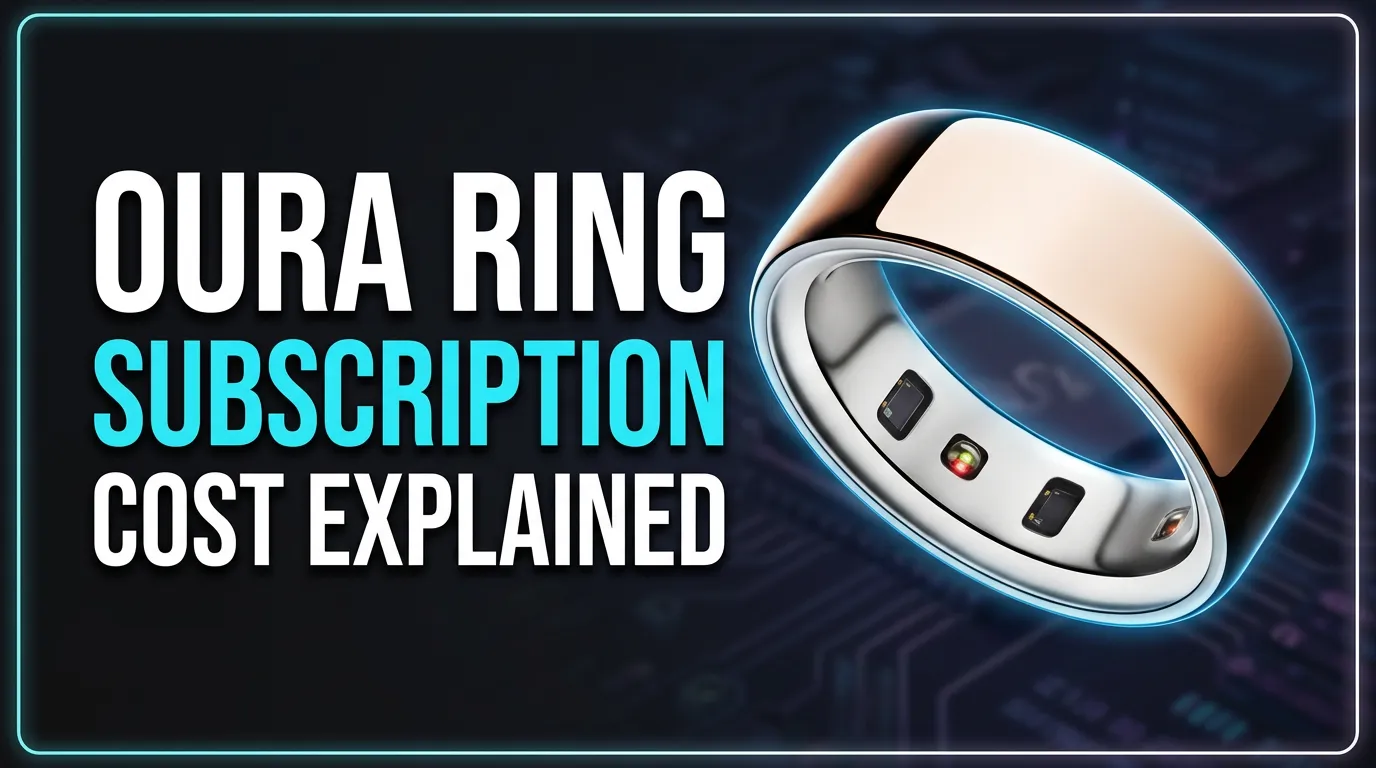
Last updated: June 2026 • Pricing verified against Oura’s official Member Care documentation
The short answer: Oura Ring 4 hardware runs $349–$499, and the membership is $5.99/month or $69.99/year in the US and EU. New members get one free month. Without a paid membership, you still see your three daily scores — Readiness, Sleep, and Activity — but you lose detailed insights, long-term trends, and personalized guidance. Over three years, expect a true total cost of roughly $553 on the base ring with the annual plan.
That’s the headline. The rest of this guide breaks down what each tier actually unlocks, where the subscription is genuinely worth it, where it isn’t, and how Oura compares to no-subscription alternatives like the Samsung Galaxy Ring, Ultrahuman Ring Air, and RingConn Gen 2.
Who this guide is for
- First-time buyers trying to understand the real cost of owning an Oura Ring beyond the sticker price.
- Existing Oura owners weighing whether to keep the monthly plan or cancel.
- Shoppers comparing Oura against no-subscription smart rings.
- Anyone confused by contradictory Reddit threads, outdated blog posts, or marketing copy.

Oura Ring subscription cost — the 2026 numbers
Pricing below is verified against Oura’s official Member Care page (June 2026). Regional taxes and currency may shift the final figure slightly.
| Plan | US Price | EU Price | Notes |
|---|---|---|---|
| Monthly membership | $5.99 / month | €5.99 / month | Cancel anytime |
| Annual membership | $69.99 / year | €69.99 / year | Saves about $2/year vs. monthly |
| Hardware (Ring 4) | $349 – $499 | Varies by finish/region | Heritage, Stealth, Brushed, Gold finishes |
| First month | Free | Free | Auto-applied when you pair a new ring |
| Family plan | Not available | Not available | Each user needs their own membership |
| Lifetime membership | Not for sale | Not for sale | Only legacy Gen 2 owners are grandfathered |
Sources: Oura Member Care — Membership page, Oura Membership product page.
Total cost of ownership (base $349 Ring 4 + annual plan)
| Year | Outlay that year | Cumulative spend |
|---|---|---|
| Year 1 | $349 + $69.99 (less ~$5.83 free month credit) | ~$413 |
| Year 2 | $69.99 | ~$483 |
| Year 3 | $69.99 | ~$553 |
| Year 5 | $69.99 × 2 more years | ~$693 |
A note on “lifetime” math: If you keep an Oura Ring for five years on the annual plan, you’ll spend roughly twice the hardware price on subscription fees alone. That’s the single most important number a first-time buyer should internalize before checkout.
What you get without a subscription (the part most blogs get wrong)
This is where almost every secondary source — including older versions of this guide — has been inaccurate. Per Oura’s own Member Care documentation, if you let your membership lapse after the free first month, your ring continues to capture and display:
- Your three daily Oura scores: Readiness, Sleep, and Activity
- Basic step count and movement data
- Battery status and charging info
- Raw heart rate display (no advanced HRV analysis)
What you lose without an active membership is the layer that turns those scores into something useful:
- Detailed sleep stage breakdown (light, deep, REM)
- Long-term trend graphs (weekly, monthly, yearly views)
- Personalized recovery and stress guidance
- Daytime stress detection and the Resilience score
- Workout heart rate zones and automatic workout detection
- Period prediction and cycle insights
- Chronotype guidance, Cardio Capacity, Cardiovascular Age, Symptom Radar
- Oura Labs experimental features
- Guided content (meditations, sleep stories, coaching)
The honest summary: without a subscription, the ring still works as a basic daily scoring device, but the interpretation layer — the part most buyers actually care about — disappears. It doesn’t become a “fancy pedometer,” but it does become a much thinner experience than what’s marketed.
What the subscription actually unlocks
Oura advertises 50+ metrics behind the paywall. For most buyers, the meaningful ones cluster into four buckets:
1. Sleep depth and recovery
- Full sleep staging (light, deep, REM, awake periods)
- Restorative time scoring
- Long-term sleep trend graphs
- Temperature trend deviations across nights
2. Stress and resilience
- Daytime Stress graph
- Resilience score (Oura’s stress-load metric, added in 2024–2025)
- HRV trends with personalized baselines
3. Activity and training
- Automatic workout detection
- Heart rate zone breakdowns during workouts
- Cardio Capacity (estimated VO₂ max)
- Cardiovascular Age estimate
4. Reproductive and women’s health
- Period prediction
- Pregnancy insights
- Optional integration with Natural Cycles
If none of those four buckets matches a problem you’re actively trying to solve, the subscription likely won’t justify itself.
Should you pay for the Oura subscription? A decision framework
Most “is it worth it” guides give you a generic list. This framework is built around the way buyers actually decide.
Pay for it if you value any of these:
| If your priority is… | Oura subscription is worth it because… |
|---|---|
| Sleep optimization | Stage-level data and long-term trends are where Oura genuinely outperforms most competitors |
| Stress and recovery tracking | The Resilience score plus HRV baselines are the most actionable feature set for chronic-stress users |
| Passive women’s health tracking | Period prediction and temperature trends are well-implemented; Natural Cycles integration extends this |
| A screenless wearable | If you actively want less screen time than an Apple Watch, the subscription is the “intelligence” that justifies that trade |
| Long-term health trends | Multi-month and multi-year views are paywalled — and they are the most valuable thing the platform offers |
Skip it (or cancel after the free month) if any of these apply:
| If this describes you… | The subscription likely isn’t worth it because… |
|---|---|
| You mainly want step counts and calorie estimates | A $30 fitness tracker — or your phone — covers this |
| You’re a serious strength or HIIT athlete | WHOOP or a Garmin gives better workout-specific data |
| You already use another sleep tracker | Stacking two trackers rarely improves decisions |
| You don’t check health apps daily | The value is in the daily feedback loop; without it, you’re paying for nothing |
| You strongly prefer one-time purchases | Look at Samsung Galaxy Ring, Ultrahuman, RingConn, or Evie instead |
The honest rule of thumb: if you can’t name a specific decision you’d make differently because of a Readiness score or a Resilience graph, you probably don’t need the paid tier.
Why Oura charges a subscription (and what you’re really paying for)
Oura’s stated rationale (per CEO Tom Hale and the company’s Pulse blog) is that ongoing access funds algorithm updates, new features, and platform development. In 2024–2025, that included the Resilience score, expanded cardiovascular metrics, pregnancy insights, and Oura Labs experimental features.
Whether you find that fair depends on how you frame it:
- As software: $5.99/month is in line with many health and fitness apps that don’t include hardware.
- As a wearable accessory cost: It roughly doubles the lifetime cost of the device.
- As a comparison point: WHOOP charges ~$30/month (with included hardware). Most no-sub rings cost $0/month but ship with thinner analytics.
There is no objectively “right” answer here, but there is a clearly “wrong” one: paying for the subscription and then not opening the app. If you fit that pattern, cancel.
How to reduce your Oura subscription cost
Realistic ways to lower your true cost of ownership:
- Use the annual plan. $69.99 vs. $71.88/year (12 × $5.99). Small, but free money.
- Use your free first month deliberately. Set a calendar reminder two days before it auto-renews. Decide then, not in month three when cancellation feels overdue.
- Use HSA/FSA funds where eligible. Oura supports HSA/FSA payment through the Membership Hub in eligible cases. This effectively discounts the plan by your marginal tax rate. Check with your plan administrator first — eligibility is not universal.
- Buy hardware on a promo cycle. Black Friday, Cyber Monday, Prime Day, and Mother’s Day historically include better bundles or extended free trial windows.
- Don’t double up. Membership is tied to your account, not the ring. Adding a second household member requires a second membership at full price — there’s no family discount.
- If you upgrade, expect no second free trial. Activating a new ring under an existing account does not reset the complimentary month.
Oura Ring lifetime membership: the honest status in 2026
Oura no longer sells lifetime memberships. The only accounts that still have one are:
- Early Gen 2 owners who activated before the subscription model took effect.
- A limited group of Gen 3 beta testers who were grandfathered in during the transition.
- A small number of accounts retained from promotional or transitional periods.
Two things to know if you’re considering a used ring:
- Lifetime membership status is tied to the original account and does not transfer with a resold ring.
- Buying a “lifetime included” Oura on a marketplace is almost always a scam or a misunderstanding by the seller. Verify by asking the seller to log in and screenshot the active membership status — then assume you’ll be paying $5.99/month anyway.
Oura + Natural Cycles: the subscription stacking question
If you found this article searching for “Oura Ring subscription cost Natural Cycles,” here’s the practical answer:
- Oura integrates with Natural Cycles, the FDA-cleared digital birth control app, using the ring’s overnight temperature data.
- Natural Cycles is a separate subscription from Natural Cycles AB — not part of Oura Membership.
- Pricing is set by Natural Cycles directly and varies by region; check their current pricing on the Natural Cycles website before assuming any number.
- Practical impact: if you want to use Oura as your temperature input for Natural Cycles, you’re looking at two subscriptions stacked on top of the hardware cost. Budget accordingly.
For some users, that combined cost is still cheaper than dedicated fertility wearables. For others, a single-purpose device makes more sense. Run the math against your actual use case before stacking.
Oura vs. no-subscription alternatives
A practical comparison, focused on the trade-offs that matter at checkout:
| Ring | Hardware price | Subscription | Where it wins | Where it loses |
|---|---|---|---|---|
| Oura Ring 4 | $349–$499 | $5.99/mo or $69.99/yr | Sleep depth, Resilience/HRV baselines, ecosystem maturity | Recurring cost; less interesting if you skip the sub |
| Samsung Galaxy Ring | ~$399 | None | Deep Galaxy phone integration, no recurring fees | Limited utility on iPhone; ecosystem-locked |
| Ultrahuman Ring Air | ~$349 | None | Metabolic/circadian framing, glucose integration option | App is less polished; smaller community |
| RingConn Gen 2 | ~$299 | None | 10–12 day battery, lowest entry price | Thinner sleep analytics than Oura |
| Evie Ring | ~$269 | None | Women’s health–first design, comfortable form factor | Limited stress/recovery depth |
| WHOOP 4.0 | $0 device | ~$30/mo (hardware included) | Best-in-class workout/strain data for athletes | No ring form factor; subscription is mandatory |
The buying logic: if Oura’s specific paywalled features (Resilience, full sleep staging, long-term trends) aren’t your priority, a no-subscription ring almost always wins on total cost of ownership. If those features are the reason you want a ring, the subscription is the product.
Why people cancel Oura (and why some come back)
This is the question the SERP undersells. Based on recurring themes in r/ouraring discussions and customer feedback patterns, the common cancellation drivers are:
- Subscription fatigue. Users who already pay for Netflix, a gym, Apple One, and a meditation app hit a tipping point. Oura is often the first health subscription cut when budgets tighten.
- Plateaued insights. After 6–12 months, daily scores feel repetitive. The novelty fades faster than the bill does.
- Workout limitations. Lifters and HIIT athletes consistently report that Oura under-detects strength sessions, which pushes them toward WHOOP, Garmin, or Apple Watch.
- No-sub alternatives improving fast. Samsung Galaxy Ring and Ultrahuman have closed enough of the gap that the price-sensitive segment now has real choices.
- Aging hardware. Older Gen 3 owners worry about battery degradation and whether the next ring will still feel worth a $349+ replacement.
People come back primarily for two reasons: a major life event that re-introduces a tracking need (pregnancy, recovery from illness, a sleep disorder), or a feature drop they actually use (Resilience and Symptom Radar pulled some lapsed users back in 2024–2025).
The honest takeaway: if you’re already wavering after a few months, your data has changed less than your appetite for looking at it. That’s information too.
Common mistakes when buying an Oura Ring
- Assuming the ring is useless without a subscription. It isn’t. You still get the three core scores. It’s just thinner.
- Skipping the sizing kit. Fingers swell at night by up to a full size. Order the free sizing kit before the ring itself, or you’ll be doing a return.
- Wearing it on the dominant hand. Most users get cleaner readings on the non-dominant index, middle, or ring finger.
- Expecting medical-grade accuracy. Oura is a wellness device, not a diagnostic tool. Sleep staging accuracy against polysomnography sits in the moderate range, especially for deep sleep — a useful trend signal, not a clinical reading.
- Pairing it with heavy lifting without a cover. Titanium scratches. A silicone cover during gym sessions extends its life.
- Auto-renewing without re-evaluating. Set a reminder before each annual renewal. If you haven’t opened the app in two weeks, that’s the answer.
FAQ
Is there a monthly fee with Oura Ring?
Yes. Oura Membership costs $5.99/month or $69.99/year in the US and EU. New members receive one complimentary month when they pair a new ring.
Is the Oura Ring worth it without a subscription?
It depends on what you want from it. You will still see your three daily scores — Readiness, Sleep, and Activity — but you lose stage-level sleep data, long-term trends, stress and recovery insights, workout heart rate zones, and personalized guidance. For most buyers, the subscription is what makes the ring feel meaningfully different from a basic tracker.
Why are people ditching Oura Rings?
The most cited reasons are subscription fatigue, plateaued insights after the first year, weaker workout tracking compared to dedicated athlete wearables, and the rise of competent no-subscription alternatives like the Samsung Galaxy Ring and Ultrahuman Ring Air.
Does Oura help with migraines?
Some users find the temperature, sleep, and stress data useful for identifying personal migraine triggers. Oura does not make migraine-specific medical claims, and this should not replace guidance from a clinician. Treat it as a journaling aid, not a treatment.
Is the Oura subscription HSA/FSA eligible?
In many cases, yes — Oura supports HSA/FSA payment through the Membership Hub. Eligibility depends on your specific plan administrator, so confirm before you assume.
Is there still an Oura lifetime membership?
No. Oura no longer sells lifetime memberships. Only a small number of legacy Gen 2 and early Gen 3 accounts retain it, and the status does not transfer when a ring is resold.
How much does Oura cost in Europe?
Membership is €5.99/month or €69.99/year in the EU, matching the US pricing in local currency. Hardware pricing varies by finish, VAT, and region.
Which finger is best for the Oura Ring?
Oura recommends the index finger for most users, on the non-dominant hand. The middle or ring finger can also work — fit and comfort matter more than finger choice for accuracy.
Can I share a membership with my family?
No. Each ring needs its own account, and each account needs its own membership. There is no family plan as of June 2026.
Bottom line
Oura’s pricing is straightforward; the value question is not.
- If you specifically want sleep staging, long-term trends, and stress/recovery analytics in a screenless form factor, the $5.99/month is one of the more honestly priced wellness subscriptions on the market.
- If you mainly want activity tracking, or you’ve already drifted away from checking the app daily, you’re paying for a feature loop you’ve stopped using.
- If you want a smart ring without recurring fees at all, the Samsung Galaxy Ring, Ultrahuman Ring Air, RingConn Gen 2, and Evie Ring are now genuine alternatives worth comparing on their own merits.
The fairest test: try the first month deliberately. Open the app daily. At day 25, ask whether any decision you made that month changed because of what the ring told you. If yes, keep it. If no, cancel — and don’t feel bad about it.
Check current pricing if Oura is the right fit
If this guide convinced you Oura matches your priorities, the most reliable way to confirm current pricing and bundle availability is directly through Oura or a major retailer. Make sure to order the free sizing kit before the ring itself.
Affiliate disclosure: NexraGear may earn a commission on qualifying purchases made through links on this page, at no additional cost to you. We link to products we believe are credible options for the use case discussed; we do not adjust recommendations based on commission rates. See our Affiliate Disclosure for full details.