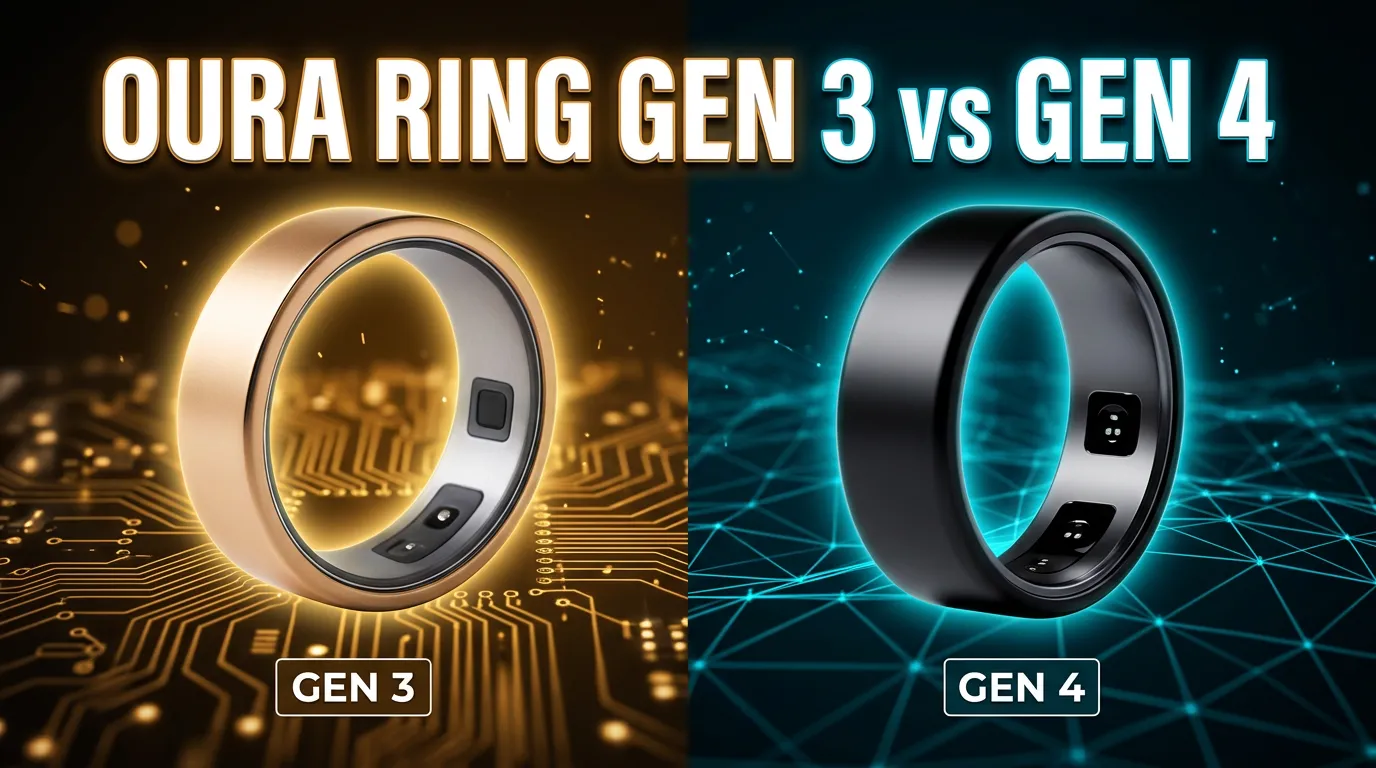
Disclosure: We may earn a commission if you purchase through links in this article. This doesn’t affect our recommendations. Full affiliate disclosure.
Quick Verdict
If you’re buying new today, the Oura Ring Gen 4 is the better choice for most people — but the gap is narrower than you might think, and the newly announced Oura Ring 5 (shipping June 4, 2026) complicates the decision.
| Oura Ring Gen 4 | Oura Ring Gen 3 | Oura Ring 5 (New) | |
|---|---|---|---|
| Starting Price | $349 (Silver/Black) | ~$199–249 (clearance) | $399 (Silver/Black) |
| Best For | 24/7 wearers wanting maximum accuracy and exclusive health metrics | Budget-conscious buyers, first-time smart ring users | Those wanting the smallest form factor + newest features |
| Bottom Line | Worth the premium if comfort and data consistency matter to you daily | Proven sleep tracking at the lowest entry price — but no longer sold directly by Oura | 40% smaller, $50 more than Gen 4, ships June 4 |
The short version:
- Buy Gen 3 if you want the cheapest way into Oura’s ecosystem and don’t need Cardiovascular Age tracking
- Buy Gen 4 if you want the best current balance of comfort, accuracy, and features
- Consider waiting for Ring 5 if you want the smallest ring possible, live activity tracking, or new women’s health features — but expect a $50–150 price premium
Why This Decision Got Harder in 2026
Three things have changed since most Oura Ring comparisons were written:
- Oura Ring 5 is real and shipping now. Officially announced May 28, 2026, it starts at $399 and ships June 4. It’s 40% smaller than Ring 4, adds live workout tracking, menopause insights, and a new Health Radar feature. Some of these software features will also come to Gen 3 and Gen 4 via app updates.
- Gen 3 is on clearance. Oura stopped direct Gen 3 sales in late 2025. Amazon and authorized retailers still have inventory, often discounted to $199–249. Once that stock is gone, it’s gone.
- Gen 4 quality concerns have surfaced. Multiple long-term users on r/ouraring report battery failures within 8–12 months, with some households seeing a 66% failure rate. Oura has generally honored replacements, but the pattern is worth knowing about before you buy.
Spec Comparison: The Hard Numbers
| Specification | Oura Ring Gen 4 | Oura Ring Gen 3 | Oura Ring 5 |
|---|---|---|---|
| Release Date | October 2024 | November 2021 | June 4, 2026 |
| Core Sensor Tech | Smart Sensing (18 signal pathways) | Standard PPG (8 signal pathways) | Redesigned Smart Sensing (12 pathways + brighter LEDs) |
| Interior Material | Full titanium | Titanium exterior + epoxy interior | Titanium |
| Sensor Profile | ~0.3mm (recessed) | ~1.3mm (raised bumps) | Low-profile sensor domes |
| Battery Life | Up to 8 days | 4–7 days | 7+ days |
| Weight | 3.3–5.2g | 4–6g | Lighter than Gen 4 |
| Sizes | 4–15 | 6–13 | 6–13 |
| Water Resistance | 100m | 100m | 100m |
| Charging Dock | USB-C, metal, gold-plated contacts | USB-A, plastic | USB-C + optional portable charging case |
| Base Price | $349 | ~$199–249 (clearance) | $399 |
| Premium Finish Price | $399–499 | $349–499 (varies by retailer) | $499 |
| Subscription | $5.99/mo or $69.99/yr | $5.99/mo or $69.99/yr | $5.99/mo or $69.99/yr |
| HSA/FSA Eligible | Yes (ring + subscription) | Yes (ring + subscription) | Expected yes |
| Cardiovascular Age | Yes (exclusive) | No | Yes |
| VO₂ Max | Yes | Yes (via firmware update, 2024) | Yes |
| Live Activity Tracking | No | No | Yes (via phone GPS) |
| Menopause Insights | No | No | Yes |
| Warranty | 1 year | 1 year | 1 year |
Gen 3 release date corrected: It launched November 2021, not “Late 2022” as sometimes misreported. The Horizon variant arrived later in the Gen 3 lifecycle, which may cause confusion.
Comfort & Build: The Difference You’ll Actually Notice
This is where the generations diverge most sharply — and where Ring 5 doubles down.
The Sensor Bump Problem (Gen 3 vs Gen 4)
Gen 3 has three raised sensor domes on the inside of the ring. They protrude roughly 1.3mm. For most daily activities this is fine. But long-term wearers report those bumps press into the skin of the finger, leaving visible indentations — “finger dents” — that can persist for hours after removing the ring. This gets worse during activities where the ring presses against something: gripping barbells, doing pull-ups, or sleeping on your hand.
Gen 4 eliminated this entirely. The sensors are recessed to about 0.3mm, creating a nearly flat interior surface. The difference is immediately noticeable.
Ring 5 continues the recessed approach with redesigned, even lower-profile sensor domes and a 40% smaller overall form factor. According to Runner’s World’s initial hands-on, the smaller size makes it noticeably less obtrusive during strength training — a real practical improvement for gym-goers.
Materials: Epoxy Interior vs. Full Titanium
Gen 3 uses a titanium exterior but an epoxy resin interior around the sensor bumps. Gen 4 went to an all-titanium build. The practical impact: Gen 4 feels denser and more durable, and the epoxy in Gen 3 can degrade over years of exposure to sweat, soap, and heat.
Ring 5 sticks with titanium but adds improved scratch resistance through a strengthened coating — a direct response to complaints about scratched finishes on Gen 3 and Gen 4.
The Heritage vs. Horizon Distinction (Gen 3 Only)
Gen 3 comes in two design variants that many buyers don’t know about:
- Heritage: Flat top surface with angled sides. Looks like a modern signet ring. Available in Silver, Black, Stealth, and Gold.
- Horizon: Fully rounded dome with no flat edges. Looks like a traditional smooth band. Available in Silver, Black, Stealth, Gold, Brushed Titanium, and Rose Gold.
The sensors and features are identical between Heritage and Horizon. The difference is purely aesthetic and comfort-related. The Horizon’s rounded edges tend to feel less obtrusive, especially on the middle finger, while the Heritage’s flat top makes the ring sit more deliberately on the finger. Horizon starts at $349 (Silver/Black); Heritage starts at $299 (Silver/Black).
Gen 4 dropped the Heritage/Horizon naming and consolidated into a single dome-style design with multiple finish options.
Finish & Color Options Across Generations
| Finish | Gen 3 Heritage | Gen 3 Horizon | Gen 4 | Ring 5 |
|---|---|---|---|---|
| Silver | ($299) | ($349) | ($349) | ($399) |
| Black | ($299) | ($349) | ($349) | ($399) |
| Stealth (matte) | ($399) | ($449) | — | ($499) |
| Brushed Silver | — | ($449) | ($399) | ($499) |
| Gold | ($449) | ($499) | ($499) | ($499, redesigned) |
| Rose Gold / Deep Rose | — | ($549) | ($499) | ($499, Deep Rose replaces Rose Gold) |
| Ceramic (Petal/Tide/Cloud) | — | — | ($499) | — |
Gen 3 pricing reflects original MSRP; current clearance prices vary by retailer. Ring 5 pricing confirmed by Forbes and Oura’s official announcement.
The Gold Comparison: Gold is the most expensive finish across all generations. Gen 3 Heritage Gold originally retailed at $449; Gen 3 Horizon Gold at $549; Gen 4 Gold at $499. Ring 5 Gold is $499 with a redesigned finish that Oura says is “more aligned to true gold.” In practical terms, gold finishes show wear and scratches more visibly than silver or black — something to factor in if you work with your hands.
Sensor Accuracy & Health Data: What Actually Changes
Smart Sensing Explained (Without the Marketing)
Gen 3 uses 8 fixed signal pathways — essentially 8 paths between the LEDs and photodetectors that read blood flow through your finger. These pathways are static; the ring can’t dynamically adjust which ones it relies on.
Gen 4’s Smart Sensing system has 18 signal pathways and uses machine learning to choose which paths deliver the cleanest signal at any given moment. It adjusts LED brightness and sampling frequency based on your finger’s blood flow characteristics, skin tone, and movement patterns.
Ring 5 takes a different approach: 12 signal pathways (fewer than Gen 4), but with larger, brighter LEDs and redesigned sensor domes that Oura says provide better skin contact and more consistent readings across different finger types and skin tones. It’s not a simple “more = better” equation — Ring 5 trades pathway count for LED quality and dome design.
What the Accuracy Numbers Actually Mean
The sleep staging accuracy figures that get cited frequently — 84% for Gen 4 and 79% for Gen 3 versus polysomnography — come from a 2024 Brigham and Women’s Hospital study that compared several consumer wearables against clinical sleep monitoring. The study found Oura had the highest sensitivity for deep sleep detection (79.5%) and wake detection (68.6%) among the devices tested.
But here’s what those numbers mean in practice: both rings are reliable for tracking trends in your sleep patterns — whether you’re getting more or less deep sleep, whether your HRV is rising or falling. They are not medical devices and should not be used to diagnose sleep disorders. As sleep researcher Dr. Matthew Walker (UC Berkeley) has noted in public talks, consumer sleep trackers are “directionally accurate for sleep timing and efficiency” but the absolute sleep stage minutes shouldn’t be treated as clinical fact.
Gen 4-Exclusive: Cardiovascular Age
This is the only hardware-exclusive metric that Gen 3 cannot receive through any software update. Cardiovascular Age estimates the biological age of your cardiovascular system by measuring pulse wave velocity (PWV) and analyzing age-related changes in your heartbeat signal.
A cardiovascular age lower than your actual age suggests good cardiovascular health; higher suggests cardiovascular stress. This metric requires the 18-pathway Smart Sensing architecture to calculate — it’s not available on Gen 3’s 8-pathway hardware.
For users with specific cardiovascular health concerns or family history, this single metric may justify the Gen 4 price difference.
What Both Rings Share
Despite the hardware differences, both Gen 3 and Gen 4 run the same Oura app with the same $5.99/month subscription. The October 2024 app redesign — with its three-tab structure (Today, Vitals, My Health) — rolled out to both generations simultaneously. Both receive most software features:
- Sleep Score and staging
- Readiness Score
- Activity Score
- Cycle Tracking (temperature-based)
- Stress Resilience
- Automatic Workout Detection
- VO₂ Max / Cardio Capacity (Gen 3 received this via firmware update in 2024)
- Dexcom Glucose Integration
The only software feature exclusive to Gen 4 hardware is Cardiovascular Age. Everything else is app-level and available to both.
What Ring 5 Adds That Older Rings Won’t Get
According to Oura’s official announcement and Runner’s World:
- Live Activity Tracking: Start a workout in the app and follow pace, distance, and heart rate in real time (uses your phone’s GPS). This is hardware-dependent and exclusive to Ring 5.
- Health Radar: An evolution of the existing Symptom Radar, providing continuous biometric monitoring to identify potential health issues proactively. Some aspects may come to older rings via software update.
- Menopause Insights: A research-driven clinical questionnaire and personalized dashboard for tracking menopause symptoms against biometric data. Available on Ring 5.
- Hormonal Birth Control Tracking: Adapts Cycle Insights for users on pills, IUDs, implants, and other hormonal methods.
Oura has stated that some new software features will roll out to Gen 3 and Gen 4 users, but live activity tracking is hardware-dependent.
Battery & Daily Durability
Real-World Battery Expectations
Manufacturer battery claims tend to be optimistic. Here’s a more realistic breakdown based on aggregated user reports and consistent patterns across reviews:
| Usage | Gen 4 | Gen 3 |
|---|---|---|
| Standard use (sleep + activity tracking) | 6–8 days | 4–5 days |
| Heavy workout tracking enabled | 4–6 days | 3–4 days |
| All features active (SpO2, stress monitoring) | 5–7 days | 3–5 days |
Both rings charge quickly — 10–15 minutes gives roughly one day of power. This means you can maintain near-continuous tracking by charging during a morning shower or evening routine.
Long-Term Battery Degradation
Lithium polymer batteries degrade over time. After 18–24 months, expect noticeable capacity loss. This affects both generations. However, the battery degradation issue with Gen 4 appears to be more than just normal aging — see the quality concerns section below.
Ring 5 introduces a portable aluminum charging case that stores approximately four full ring charges. With a 7+ day battery life, that’s potentially a month of use without needing a wall outlet — useful for travel.
The Subscription Reality
Both rings require Oura Membership ($5.99/month or $69.99/year) for full functionality. Without it, you get basic step counting and manual heart rate spot checks. That’s it. No sleep scores, no readiness scores, no trends, no advanced metrics.
In practical terms, the subscription is not optional if you want the product to deliver on its purpose. Factor $70/year into your total cost calculation.
Sizing: The Most Important Decision You’ll Make
Sizing is the single most common reason for Oura Ring returns. Getting it wrong means either returning the ring or living with uncomfortable wear. Here’s what you need to know.
Gen 3 and Gen 4 Sizing Kits Are NOT Interchangeable
Gen 4’s internal dimensions differ from Gen 3 due to the recessed sensor architecture. Even if you wore a Gen 3 size 9, your Gen 4 size may feel slightly different. The consensus from r/ouraring users: Gen 4 feels about half a size larger than the same number in Gen 3 because the flatter interior doesn’t grip the finger as tightly.
| Sizing Aspect | Gen 3 | Gen 4 |
|---|---|---|
| Size range | 6–13 | 4–15 (expanded) |
| Internal sensor bump | 1.3mm raised | 0.3mm recessed |
| Fit at same numeric size | Snugger | Slightly looser |
| Sizing kit credit | $10 (applied at checkout) | $10 (applied at checkout) |
If you’re between sizes: Size down for Gen 4 (the recessed sensors make it feel roomier), size up for Gen 3 (the raised bumps make it feel tighter).
Ring 5 sizing: The Ring 5 goes back to sizes 6–13 (dropping the 4 and 5 and 14–15 options from Gen 4) and uses size-specific charging cases. If you were using an extended Gen 4 size, verify that Ring 5 has your size before pre-ordering.
How to Size Correctly
- Order the sizing kit first. Do not guess based on jewelry store measurements. Oura uses non-standard sizing.
- Wear the sizing ring for at least 48 hours. Your finger size fluctuates throughout the day:
- Morning: smallest (overnight dehydration)
- Evening: largest (fluid retention, activity)
- Post-workout: temporarily swollen
- Test on the correct finger. Oura recommends index or middle finger on either hand, but not your dominant hand’s ring finger.
- Buy the sizing kit from the same retailer where you’ll buy the ring. The $10 credit applies only at the same store.
- Remember you’re making a multi-year decision. This ring needs to fit comfortably 24/7. Don’t rush this step.
What Reddit Actually Says: Community Consensus & Gen 4 Quality Concerns
No Oura Ring comparison is complete without addressing what long-term users report. The r/ouraring community (over 100K members) provides the most candid feedback available.
The Gen 4 Quality Control Pattern
Multiple threads over the past year document a pattern of Gen 4 battery failures within the first 8–12 months:
- A February 2026 thread from a 5-year user reported that 2 out of 3 Gen 4 rings purchased in April 2025 had failed within 10 months — both showing the same pattern of overnight tracking stopping while battery still showed ~30%.
- A July 2025 thread from a user with an extended-size Gen 4 (size 5) reported going through three rings in under eight months, each failing with the same battery issue.
- In the same thread about Gen 3 vs Gen 4 differences, one user stated: “Gen4 is notorious for QC issues, almost guaranteed to fail within the year.”
The counterpoint: Oura has generally replaced defective rings under warranty. The replacement process is reportedly straightforward, though some users have received refurbished units rather than new ones, and the warranty isn’t extended from the original purchase date.
What this means for buyers: Gen 4’s 1-year warranty is meaningful. If you’re buying Gen 4, keep documentation and don’t hesitate to contact Oura support if battery life drops sharply. For extended-size rings, the failure reports appear more frequent.
The General Consensus on Gen 3 vs Gen 4
The most common sentiment from actual users, distilled from dozens of threads:
Gen 3 owners who upgraded to Gen 4 say:
- The comfort improvement from recessed sensors is real and significant
- Data gaps during sleep and workouts are noticeably reduced
- The finger dent issue goes away completely
- But the data itself — sleep scores, HRV, readiness — isn’t dramatically different
Gen 3 owners who did NOT upgrade say:
- “Gen 3 still works fine and the data is basically the same”
- The 18 vs 8 pathway difference sounds more important on paper than in daily use
- The subscription is the same either way
From a thread asking “Is Oura 4 so much better than the 3?”: The top-voted answer was: “The Gen 4 is not so much better than the Gen 3. In my research, the data provided by both is the same.”
The Honest Workout Tracking Assessment
Neither Gen 3 nor Gen 4 is a reliable workout tracker for high-intensity or arm-intensive exercise. Period.
Walking, hiking, and low-impact cardio track well. Weightlifting, HIIT, running, and any exercise with significant arm movement produce inconsistent heart rate data from both generations.
Gen 4’s 18-pathway system captures more consistent data during movement than Gen 3, but it’s still not on par with a dedicated fitness watch. The practical recommendation from both reviewers and the community: wear an Oura ring for 24/7 recovery and sleep insights, and use a Garmin, Apple Watch, or similar device for workout-specific metrics.
Ring 5’s new live activity tracking may begin to address this gap by using your phone’s GPS for real-time pace and distance during runs, but it’s too early to assess its accuracy.
Oura Ring 5: What It Means for Your Decision Right Now
The Oura Ring 5 officially launched May 28, 2026, with pre-orders open and shipping starting June 4. Here’s the decision framework.
What Ring 5 Confirmed
Based on Oura’s official announcement, Forbes, and Runner’s World:
- 40% smaller and lighter than Ring 4 — claimed to be the world’s smallest smart ring
- $399 starting price (Silver/Black), $499 for premium finishes (Stealth, Brushed Silver, Gold, Deep Rose)
- 12 signal pathways with larger, brighter LEDs and redesigned sensor domes
- 7+ day battery with optional portable charging case (holds 4 full charges)
- Sizes 6–13 (note: smaller range than Gen 4’s 4–15)
- New features: Live Activity Tracking, Menopause Insights, Hormonal Birth Control tracking, Health Radar
- Same subscription: $5.99/month or $69.99/year
- Titanium construction with improved scratch resistance
What Ring 5 Does NOT Change
- It does not measure blood pressure (Oura is pursuing FDA clearance, expected via software update in late 2026–2027)
- The core health metrics are the same as Ring 4 (sleep, HRV, SpO2, temperature, cardiovascular age, VO₂ max)
- It’s a refinement generation, not a leap — smaller, more comfortable, with software additions
The Decision Matrix
| Your Situation | Recommendation |
|---|---|
| Need a ring now, budget under $300 | Gen 3 — best value entry point while clearance stock lasts |
| Need a ring now, want best current hardware | Gen 4 — proven, comfortable, full feature set |
| Want the smallest, newest ring and can wait until June 4 | Ring 5 — $399+, 40% smaller, live tracking |
| Current Gen 3 owner, works fine | Keep Gen 3 — the data is very similar |
| Current Gen 3 owner, frustrated by data gaps or comfort | Ring 5 — addresses both issues |
| Extended-size Gen 4 user (size 4, 5, 14, or 15) | Verify Ring 5 sizing — it only goes 6–13 |
Alternatives: How Other Smart Rings Compare
If you’re comparing on price or features, here’s how the broader market looks:
| Ring | Price | Subscription | Key Differentiator |
|---|---|---|---|
| Our Ring Gen 3 | ~$199–249 | $5.99/mo | Proven sleep accuracy, mature app, 40+ integrations |
| Oura Ring Gen 4 | $349+ | $5.99/mo | Best overall health tracking, Cardiovascular Age |
| Oura Ring 5 | $399+ | $5.99/mo | Smallest form factor, live activity tracking |
| RingConn Gen 2 Air | $199 | None | No subscription required, basic tracking |
| Samsung Galaxy Ring | ~$349 | None (requires Samsung phone) | Deep Samsung ecosystem integration, no subscription |
| Ultrahuman Ring Air | $349 | None | Strong metabolic health tracking, no subscription |
Oura’s advantage: Peer-reviewed validation (the Brigham and Women’s Hospital sleep study), the most mature app ecosystem with 40+ integrations (Apple Health, Strava, etc.), and consistent feature development. The subscription funds ongoing research and software updates.
Oura’s disadvantage: The mandatory subscription adds $70/year to the total cost, and Gen 4 quality concerns haven’t been fully addressed.
Who Should Buy What: By Use Case
The Budget-Conscious First-Timer
→ Gen 3 (if you can find it at clearance pricing)
At ~$199–249, Gen 3 is the cheapest way into Oura’s ecosystem. You get the same app, same subscription, most of the same features, and clinically validated sleep tracking. You’ll deal with more data gaps, the finger dent issue, and no Cardiovascular Age — but the core experience is solid. Buy from a retailer with a 30-day return policy.
The 24/7 Health Optimizer
→ Gen 4 (or Ring 5 if you value the smaller size)
If you wear a ring constantly and care about data consistency, comfort, and having the latest metrics, Gen 4 delivers. The recessed sensors, better battery, and exclusive Cardiovascular Age metric justify the premium over Gen 3 for daily wearers. If the 40% smaller form factor of Ring 5 matters to you (especially for gym use or small hands), the extra $50 is worth it.
The Sleep-Focused Tracker
→ Either Gen 3 or Gen 4
Both generations deliver very similar sleep data. Gen 4 has slightly fewer data gaps and better SpO2 accuracy, but for pure sleep tracking, the practical difference is modest. Gen 3 at clearance pricing is the smart financial play.
The Woman Tracking Fertility, Cycle, or Menopause
→ Ring 5 (for menopause) or Gen 4 (for fertility/cycle)
Ring 5 introduces Menopause Insights and Hormonal Birth Control tracking — both significant additions for women’s health. For fertility and general cycle tracking, Gen 4’s improved sensor accuracy (30% better SpO2, 18 pathways) provides more reliable temperature deviation detection than Gen 3, which matters for ovulation tracking.
The Athlete
→ Gen 4 or Ring 5, paired with a fitness watch
No Oura ring replaces a dedicated fitness tracker for workout-specific metrics. But for 24/7 recovery monitoring, HRV trends, and readiness scores, Oura excels. Gen 4 or Ring 5 provide more consistent data during movement than Gen 3. The new live activity tracking in Ring 5 may be useful for runners.
The Current Gen 3 Owner Debating an Upgrade
→ Upgrade to Ring 5 if you have comfort/data issues. Otherwise, stay put.
The consensus from Gen 3 users who upgraded is clear: the improvements are real but evolutionary, not revolutionary. If your Gen 3 works well and you don’t mind the sensor bumps, there’s no urgency. If you’re experiencing data gaps, finger dents, or battery degradation, Ring 5 (or Gen 4 at a potential discount once Ring 5 ships) addresses all three.
Pricing & Total Cost of Ownership
5-Year Total Cost (Estimated)
| Cost Component | Gen 4 | Gen 3 | Ring 5 |
|---|---|---|---|
| Ring purchase | $349 (Silver/Black) | ~$224 (avg. clearance) | $399 (Silver/Black) |
| Sizing kit | $10 (credited back) | $10 (credited back) | $10 (credited back) |
| Subscription (5 × $69.99) | $349.95 | $349.95 | $349.95 |
| Optional extra charger | $59 | $59 | |
| 5-Year Total | ~$709–768 | ~$584–643 | ~$759–818+ |
Resale values are speculative and not included. Historical trend: Oura rings retain roughly 40–60% of purchase price after 2–3 years depending on condition and finish.
The practical takeaway: The total cost difference between Gen 3 and Gen 4 over 5 years is about $125 — roughly $25/year. The subscription dominates the total cost, not the ring price. If you’re hesitating between Gen 3 and Gen 4 based on price alone, the long-term difference is smaller than it feels upfront.
Ring 5 adds another $50 to the upfront cost versus Gen 4, but you get a smaller ring, live tracking, and new software features.
Frequently Asked Questions
Is the Gen 3 still worth buying in 2026?
Yes, at clearance prices ($199–249). You get proven sleep tracking with the same app and most of the same features as Gen 4. But understand the trade-offs: more data gaps, raised sensor bumps, no Cardiovascular Age, and uncertain long-term firmware support as Oura focuses development on newer hardware.
Is Oura Ring Gen 3 being discontinued?
Oura stopped direct Gen 3 sales in late 2025. Amazon and authorized retailers continue selling remaining inventory. Once stock is gone, only refurbished units may be available.
What can Gen 4 do that Gen 3 can’t?
The only hardware-exclusive feature is Cardiovascular Age — an estimate of your cardiovascular system’s biological age based on pulse wave velocity. It requires Gen 4’s 18-pathway sensor architecture and cannot be added to Gen 3 via software. All other features (VO₂ Max, stress monitoring, cycle tracking, Dexcom integration) are available on both via the shared app.
Can I use my Gen 3 sizing kit for Gen 4 or Ring 5?
No. Each generation uses model-specific sizing kits due to different internal dimensions. Always order the correct generation’s kit.
Do all Oura rings use the same app and subscription?
Yes. Gen 3, Gen 4, and Ring 5 all use the Oura app with the same $5.99/month or $69.99/year membership. Most features are shared across generations. The main differences are hardware-dependent (Cardiovascular Age requires Gen 4+; live tracking requires Ring 5).
Should I wait for Ring 5 or buy now?
Ring 5 is already available for pre-order and ships June 4, 2026. If you can wait until then, it offers a 40% smaller design, live activity tracking, and new women’s health features for $399+. If you need a ring today and want to save money, Gen 4 at $349 or Gen 3 at clearance pricing are both viable.
Which finger should I wear an Oura Ring on?
Index or middle finger on either hand. Avoid the pinky (too small, poor blood flow), thumb (too mobile), and the ring finger on your dominant hand (more size variation).
Can I shower with an Oura Ring?
All current generations are water resistant to 100 meters — safe for swimming and showering. However, hot water, soap, and chemicals degrade the seals over time. For maximum longevity, remove during hot showers, hot tubs, and saunas.
Does any Oura Ring measure blood pressure?
No. None of the currently available Oura rings (Gen 3, Gen 4, or Ring 5 at launch) measure blood pressure. Oura is pursuing FDA clearance for blood pressure estimation, which could arrive as a software update to Ring 5 in late 2026 or 2027.
Can I use an Oura Ring without a subscription?
Technically yes, but you’ll only get basic step counting and manual heart rate spot checks. You lose all scores, trends, sleep staging, advanced metrics, and the core value of the product. In practice, the subscription is necessary for the ring to deliver on its purpose.
How does Oura compare to Samsung Galaxy Ring?
The Samsung Galaxy Ring is similarly priced (~$349) with no subscription required, but it requires a Samsung phone for full functionality. Oura has broader phone compatibility, peer-reviewed sleep accuracy validation, 40+ third-party app integrations, and a more mature platform. Samsung’s ring integrates deeply with the Samsung Health ecosystem but has limited third-party support.
Final Recommendation
For most buyers in June 2026:
- Best overall value: Gen 3 at clearance pricing (~$199–249). Same core experience, lowest entry price.
- Best current hardware: Gen 4 at $349. Comfort, data consistency, Cardiovascular Age, proven track record (despite QC concerns, Oura honors warranty replacements).
- Best future-proofing: Ring 5 at $399. Smallest form factor, live tracking, newest features — but it literally just launched, so long-term reliability is unknown.
The most honest advice: Don’t overthink the generation choice. The subscription cost over 5 years ($350) will exceed whatever you save on the ring itself. Pick the one that fits your budget and comfort preferences, order the sizing kit first, and focus on building consistent sleep and health habits with the data rather than optimizing the hardware choice.
Editorial standards: Prices verified as of June 7, 2026. Product specifications sourced from Oura’s official website and verified against multiple independent reviews. Community feedback sourced from publicly available Reddit threads with direct links provided. This article may be updated as new information becomes available, particularly regarding Ring 5’s real-world performance after its June 4 ship date.
Learn more about how we review products or browse our smart ring comparisons. For questions, contact us.