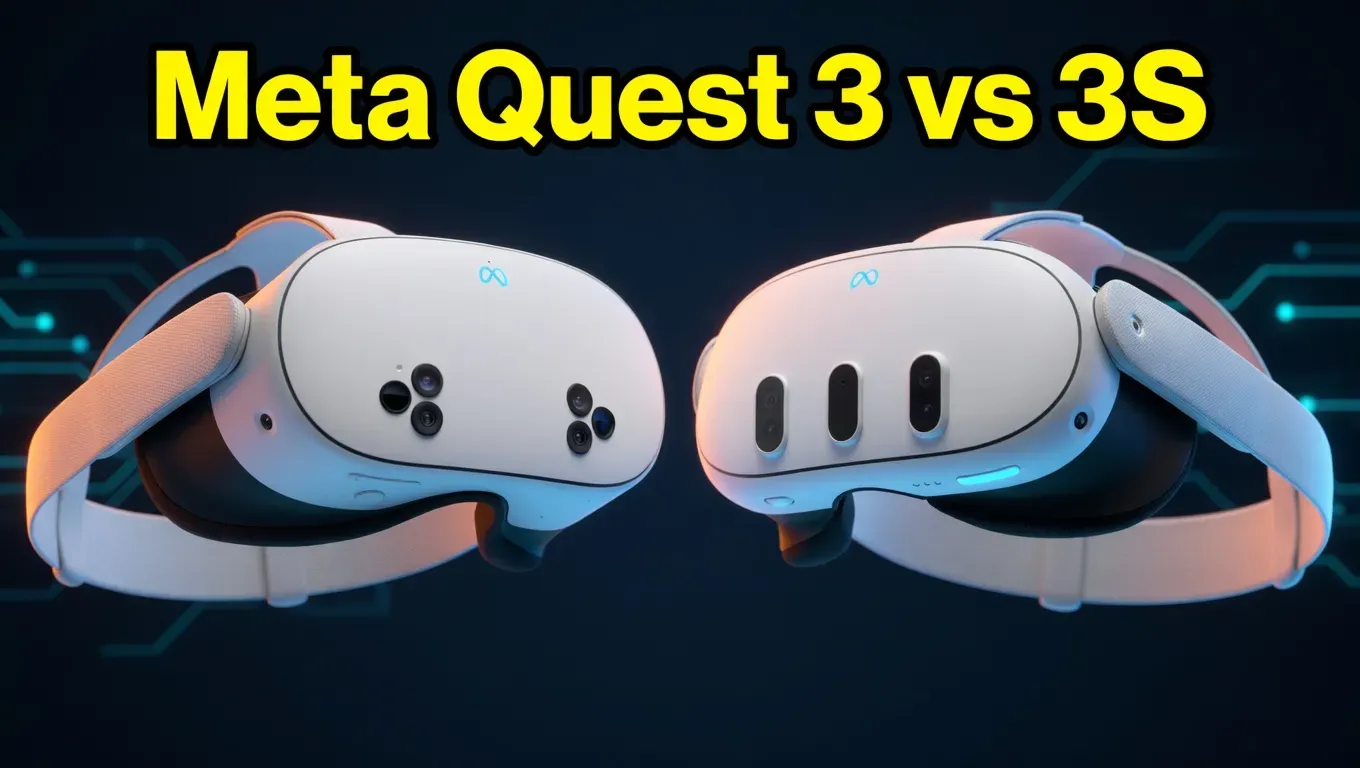
The Meta Quest 3 is the better headset if you care about visual clarity, mixed reality quality, and long-term comfort. The Meta Quest 3S is the better value if you are new to VR, buying for a younger user, or want the lowest practical entry point into Meta’s current game library.
The short version: both headsets use the Snapdragon XR2 Gen 2, both play the same Quest games, and both support standalone VR. The real decision comes down to pancake vs Fresnel lenses, resolution, field of view, IPD adjustment, audio options, storage, and price.
Quick Answer: Quest 3 vs Quest 3S at a Glance
| Category | Better Choice | Why |
|---|---|---|
| Best overall headset | Meta Quest 3 | Sharper pancake lenses, higher resolution, wider field of view, slimmer design |
| Best value | Meta Quest 3S | Same processor and game library at a lower starting price |
| Best for first-time VR buyers | Meta Quest 3S | Lower risk if you are not sure how often you will use VR |
| Best for visual clarity | Meta Quest 3 | Pancake lenses are the biggest day-to-day upgrade |
| Best for mixed reality | Meta Quest 3 | Higher clarity and dedicated depth-sensing hardware give it the edge |
| Best for families | Meta Quest 3S | Lower cost and Meta’s 10+ age guidance make it easier to justify |
| Best for PCVR users | Meta Quest 3 | Better optics make streamed PCVR games look cleaner |
| Best if you wear glasses | Meta Quest 3 | Wider sweet spot and more flexible optical adjustment help reduce blur |
Bottom line: buy the Quest 3 if you will use VR regularly. Buy the Quest 3S if price matters more than lens quality.
Meta Quest 3 vs Quest 3S Specs Comparison
| Feature | Meta Quest 3 | Meta Quest 3S |
|---|---|---|
| Lens type | Pancake lenses | Fresnel lenses |
| Resolution per eye | 2064 × 2208 | 1832 × 1920 |
| Field of view | About 110° | About 96° |
| Processor | Snapdragon XR2 Gen 2 | Snapdragon XR2 Gen 2 |
| RAM | 8GB | 8GB |
| Storage options | 512GB | 128GB or 256GB |
| Display type | Fast-switch LCD | Fast-switch LCD |
| Refresh rate | Up to 120Hz | Up to 120Hz |
| IPD adjustment | Continuous / software-assisted adjustment | 3-position physical adjustment |
| Audio | Integrated speakers + 3.5mm headphone jack | Integrated speakers, no 3.5mm headphone jack |
| Mixed reality hardware | Color passthrough + depth projector | Color passthrough with software-based depth estimation |
| Battery capacity | 5,060mAh | 4,324mAh |
| Typical active use | Roughly 2–3 hours depending on app and settings | Similar range; may edge ahead in some use due to lower resolution |
| Meta age guidance | 13+ | 10+ |
| Current official price context | Quest 3 512GB: $599.99 | Quest 3S 128GB: $349.99; Quest 3S 256GB: $449.99 |
| Best for | Enthusiasts, mixed reality, visual clarity, long-term use | Beginners, families, budget buyers |
Source check recommended before publishing: verify final pricing and availability against the official Meta Quest comparison page and product pages on the day of publication.
Pricing and Storage: 2026 Update
The 2026 price gap matters because the Quest 3S is no longer just “cheap”; it is the entry-level option in a lineup where the Quest 3 has become a more clearly premium buy.
Current pricing from the supplied update:
- Meta Quest 3 512GB: $599.99
- Meta Quest 3S 128GB: $349.99
- Meta Quest 3S 256GB: $449.99
That makes the Quest 3:
- $250 more than the Quest 3S 128GB
- $150 more than the Quest 3S 256GB
That difference is the heart of the buying decision.
If you only want to play Beat Saber, Superhot, social VR apps, fitness games, and the usual Quest library, the Quest 3S gives you the same core platform for less money. If you expect to use the headset for years, watch video, read text in VR, stream PCVR, or spend time in mixed reality, the Quest 3’s lenses are the upgrade you will notice most often.
What changed after the 2026 price update?
Older comparisons often use outdated prices. That can make the Quest 3 look like a simpler upgrade than it is now.
At $599.99, the Quest 3 is still the better headset, but the value argument is more specific: you are paying extra for better optics, higher resolution, wider FOV, slimmer design, 512GB storage, a headphone jack, and better mixed reality hardware.
At $349.99, the Quest 3S 128GB is the most sensible entry point if you are not sure VR will become a regular habit.
Display and Optics: Pancake vs Fresnel Is the Biggest Difference
The most important difference between the Quest 3 and Quest 3S is not the processor. It is the lenses.
The Quest 3 uses pancake lenses, which give you a larger clear viewing area and better edge-to-edge sharpness. You do not have to position the headset as precisely to keep the image clear.
The Quest 3S uses Fresnel lenses, similar in concept to the Quest 2. Fresnel lenses can still look good, but they have a narrower sweet spot. If the headset shifts slightly on your face, the image can look blurrier, especially around the edges.
Why lens quality matters more than it sounds
Lens quality affects almost every session:
- reading menus
- spotting detail in games
- watching video
- using productivity apps
- seeing mixed reality overlays clearly
- sharing the headset with someone whose eye spacing is different from yours
If you are only playing active games, the Quest 3S can feel perfectly fine. If you spend time reading text, watching content, or using VR for longer sessions, the Quest 3 feels more forgiving.
Resolution and field of view
The Quest 3 also has the resolution advantage:
- Quest 3: 2064 × 2208 per eye
- Quest 3S: 1832 × 1920 per eye
It also has a wider field of view:
- Quest 3: about 110°
- Quest 3S: about 96°
That does not mean the Quest 3S looks bad. It means the Quest 3 gives you a cleaner, wider, more comfortable view — especially in slower experiences where your eyes have time to notice detail.
Design, Comfort, and IPD Adjustment
The Quest 3 has a slimmer front profile because pancake lenses allow a thinner optical stack. That helps shift the weight closer to your face, which can reduce the front-heavy feeling common in VR headsets.
The Quest 3S is bulkier and closer in feel to the Quest 2. It is still usable, but the design does not feel as premium.
Corrected IPD difference
The original version of this comparison had the IPD adjustment reversed. The corrected difference is:
- Quest 3: continuous / software-assisted IPD adjustment
- Quest 3S: 3-position physical IPD adjustment
IPD, or interpupillary distance, is the distance between your pupils. If the headset’s lens position does not match your eyes well, the image can look blurry or uncomfortable.
For many single-user setups, both systems are workable. For buyers sensitive to eye comfort, or households where multiple people will share the headset, this detail is worth checking before purchase.
Audio: Both Have Speakers, but Only Quest 3 Has a Headphone Jack
Both headsets include integrated stereo speakers. You do not need separate headphones just to hear audio.
The real difference is the headphone jack:
- Quest 3: includes a 3.5mm headphone jack
- Quest 3S: does not include a 3.5mm headphone jack
That matters if you already own wired gaming earbuds or headphones and want low-latency private audio without relying on Bluetooth.
For casual use, the built-in speakers are enough. For rhythm games, competitive play, late-night sessions, or more immersive audio, the Quest 3 gives you more flexibility.
Performance and Battery Life
Both headsets use the Snapdragon XR2 Gen 2 with 8GB of RAM. That means the Quest 3S is not “weaker” in the way many buyers assume.
You get:
- the same core game library
- the same processor class
- the same RAM
- the same general software ecosystem
- standalone play without a PC
- optional PCVR streaming through Meta Air Link or USB-C cable
The Quest 3 does not win because it has dramatically better game performance. It wins because the games look better through its optics and display.
Battery life
The Quest 3 has a larger listed battery capacity at 5,060mAh, while the Quest 3S is listed at 4,324mAh. In practical buying terms, both are still short-session devices. Expect roughly a couple of hours of active use depending on game, brightness, refresh rate, wireless features, and mixed reality use.
The Quest 3S may last slightly longer in some scenarios because it drives a lower-resolution display, but neither headset is ideal for long sessions without breaks or an external battery strap.
Mixed Reality and Passthrough
Both headsets support color passthrough and mixed reality experiences. The Quest 3 is better at it.
The key hardware difference is that the Quest 3 includes a depth projector, while the Quest 3S relies more heavily on software-based depth estimation. That affects how confidently the headset understands your room and blends virtual objects with physical space.
If you mostly play standard VR games, this may not matter much. If you care about mixed reality workouts, room-scale games, spatial apps, or experimental MR features, the Quest 3 is the stronger choice.
Storage Deep Dive: 128GB vs 256GB vs 512GB
Storage is one of the easiest places to overspend — or regret saving too much.
The Quest 3S comes in 128GB and 256GB versions. The Quest 3 is currently positioned around the 512GB model in this comparison.
Is 128GB enough on Quest 3S?
For casual buyers, yes — but with limits.
Choose 128GB if:
- you are new to VR
- you mostly play a few games at a time
- you do not mind uninstalling apps occasionally
- you want the lowest upfront price
Avoid 128GB if:
- multiple family members will use the headset
- you download many games at once
- you record lots of video
- you want to keep a large library installed
Is 256GB the better Quest 3S choice?
For most Quest 3S buyers, 256GB is the safer middle ground. It gives you more breathing room without jumping to the Quest 3’s premium price.
Choose Quest 3S 256GB if you want the lower-cost headset but do not want storage management to become annoying within the first year.
Who actually needs 512GB?
The Quest 3 512GB makes sense if you:
- install a large game library
- share the headset with family
- record media often
- use the headset frequently
- want fewer storage decisions over time
It is not mandatory for everyone. It is convenience.
Can you expand Quest storage with a memory card?
No. The Quest 3 and Quest 3S do not support microSD storage expansion. If you buy too little storage, your main option is deleting apps and reinstalling them later.
That is why storage should be part of the purchase decision, not an afterthought.
Quest 3 vs Quest 3S vs Quest 2: Is the 3S Just a Quest 2 Upgrade?
The Quest 3S is best understood as a budget bridge between the Quest 2 and Quest 3.
It brings the newer processor and mixed reality direction of the Quest 3 ecosystem, but it keeps Fresnel-style optics closer to the Quest 2 experience.
If you already own a Quest 2, the Quest 3S is an upgrade in processing and passthrough, but it may not feel like a major optical upgrade. If your biggest frustration with Quest 2 is blur, sweet spot, or lens clarity, the Quest 3 is the more meaningful jump.
Quest 3 vs Quest Pro, PSVR2, and Apple Vision Pro: Where These Fit
This article is focused on the Quest 3 and Quest 3S, but buyers often compare them against nearby alternatives.
Quest Pro
The Quest Pro is not the obvious buy for most shoppers in 2026 unless you have a specific reason to want its design or feature set. For mainstream VR gaming and mixed reality, the Quest 3 remains the cleaner recommendation for most people.
PlayStation VR2
PSVR2 can make sense if you already own a PlayStation 5 and want console VR. It is not a standalone headset in the same way the Quest 3 and Quest 3S are, so it serves a different buyer.
Apple Vision Pro
Apple Vision Pro sits in a much higher price and use-case category. It is more relevant as spatial computing context than as a direct alternative for most Quest buyers.
Pico 4 Ultra and other VR headsets
Other headsets may compete on specific hardware features, but Meta’s biggest advantage remains its standalone app ecosystem, game library, and mainstream accessory support.
Which Headset Is Right for You?
Buy the Meta Quest 3 if…
Choose the Quest 3 if you:
- care about visual clarity
- dislike blurry edges
- plan to use VR weekly or more
- want the best mixed reality experience of these two
- will watch video or read text in VR
- use PCVR streaming
- want 512GB storage
- want a 3.5mm headphone jack
- are upgrading from Quest 2 and want the upgrade to feel obvious
The Quest 3 is the better long-term headset. Its advantage is not raw speed; it is the quality of what you see every time you put it on.
Buy the Meta Quest 3S if…
Choose the Quest 3S if you:
- are buying your first VR headset
- want the lowest practical price
- are buying for a child or family member
- mostly care about games, not mixed reality
- do not mind Fresnel lenses
- would rather spend the price difference on games or accessories
- are unsure whether VR will become a regular habit
The Quest 3S is not a bad headset. It is a cost-cut version of the current Quest platform with the biggest compromise placed in the lenses and display.
Decision Matrix: The Fastest Way to Choose
| Buyer type | Recommended headset | Reason |
|---|---|---|
| First-time VR buyer | Quest 3S 128GB or 256GB | Lower risk and same game library |
| Frequent adult gamer | Quest 3 | Better lenses matter over hundreds of sessions |
| Family buyer | Quest 3S 256GB | Good balance of price and storage |
| Mixed reality enthusiast | Quest 3 | Better clarity and depth hardware |
| PCVR streamer | Quest 3 | Better optics improve streamed games |
| Budget buyer | Quest 3S 128GB | Lowest entry price |
| Storage worrier | Quest 3 512GB | Least library management |
| Quest 2 owner | Quest 3 | More meaningful visual upgrade |
| Wired headphone user | Quest 3 | Has 3.5mm jack |
| Younger user in Meta’s age range | Quest 3S | Meta lists lower age guidance than Quest 3 |
Affiliate Buying Guidance: Check Current Pricing Before You Decide
Prices and bundles change often, especially around holidays and retailer promotions. Use the recommendation above first, then check current pricing.
If the Quest 3 fits your needs:
Check current Meta Quest 3 pricing and availability
Best for visual clarity, mixed reality, PCVR streaming, and long-term use.
If the Quest 3S fits your needs:
Check current Meta Quest 3S pricing and availability
Best for first-time VR buyers, families, and anyone trying to keep the upfront cost lower.
Affiliate disclosure: NexraGear may earn a commission if you buy through affiliate links. This does not change the price you pay and does not affect our recommendation.
What Reddit and the VR Community Tend to Focus On
Community discussions around Quest 3 vs Quest 3S usually come back to three points:
- The lens difference is the real divider.
Many VR users describe the Quest 3S as closer to the Quest 2 visually, but with the newer Quest 3-class chip and passthrough improvements. - The Quest 3S is good value if you are new.
Budget-focused buyers often prefer saving money for games, straps, cases, or prescription lens inserts. - Quest 2 owners should think carefully before choosing 3S.
If the goal is a clear visual upgrade, the Quest 3 is the more satisfying jump.
Useful community threads to review before buying:
Community feedback should not replace specs or pricing, but it is useful for understanding which differences bother people after the first week.
Total Cost of Ownership: Do Not Forget Accessories
The headset is only part of the cost.
Most buyers eventually consider:
- a better head strap
- a battery strap
- a carrying case
- prescription lens inserts
- facial interface replacements
- games
- Meta Quest+ or other subscriptions
- Link cable or wireless PCVR setup accessories
This matters because a cheaper headset plus accessories may be a better fit than a premium headset with no budget left for games.
Practical value rule
- If buying the Quest 3 means you cannot afford games or comfort accessories, the Quest 3S may be the better overall purchase.
- If you already know you will use VR often, stretching for the Quest 3 is easier to justify because the lens advantage is present every session.
Pros and Cons
Meta Quest 3 Pros and Cons
Pros
- Pancake lenses provide much better edge-to-edge clarity
- Higher resolution per eye
- Wider field of view
- Slimmer design
- Better mixed reality hardware
- 512GB storage gives more room for games and media
- Includes 3.5mm headphone jack
- Better upgrade from Quest 2
Cons
- Costs more upfront
- Still needs accessories for best comfort
- Battery life is limited for long sessions
- Overkill for buyers who may only use VR occasionally
- Not the cheapest way into the Quest ecosystem
Meta Quest 3S Pros and Cons
Pros
- Lower starting price
- Same Snapdragon XR2 Gen 2 processor
- Same core Quest game library
- Good entry point for new VR users
- 128GB and 256GB options
- Meta’s lower age guidance makes it more family-friendly
- Lets buyers spend more of the budget on games and accessories
Cons
- Fresnel lenses have a smaller sweet spot
- Lower resolution
- Narrower field of view
- No 3.5mm headphone jack
- Mixed reality is not as strong as Quest 3
- 128GB can feel tight for larger libraries
- Less compelling for Quest 2 owners who want a clear visual upgrade
How We Evaluated This Comparison
This comparison is based on:
- official Meta headset specifications and pricing context
- current Quest 3 and Quest 3S storage tiers
- published third-party hands-on comparisons from outlets such as PCMag and VICE
- community discussions from Reddit and other VR buyer forums
- buyer-use scenarios including gaming, family use, mixed reality, storage needs, and PCVR streaming
This update does not claim new lab testing or a fresh seven-day hands-on test. The previous “7-day simulation” format has been removed because simulated use should not be presented as real experience.
For final publication, NexraGear should add direct source links near technical claims, including:
- Meta Quest headset comparison
- PCMag Quest 3 vs Quest 3S comparison
- VICE Quest 3 vs Quest 3S comparison
- relevant Reddit discussion threads linked above
Frequently Asked Questions
Is Meta Quest 3 better than Quest 3S?
Yes, the Quest 3 is the better headset overall. It has pancake lenses, higher resolution, a wider field of view, a slimmer design, a 3.5mm headphone jack, more storage, and stronger mixed reality hardware. The Quest 3S is better only if price is the main concern.
Why is the Quest 3S cheaper?
The Quest 3S is cheaper because it uses lower-cost optics and display hardware. It has Fresnel lenses, lower resolution, a narrower field of view, no 3.5mm headphone jack, and less advanced mixed reality depth hardware. It keeps the same Snapdragon XR2 Gen 2 chip, which is why performance remains strong.
Is the Quest 3S weaker than the Quest 3?
Not in processor terms. Both use the Snapdragon XR2 Gen 2 and 8GB RAM. The Quest 3S is weaker in optics, resolution, field of view, audio flexibility, storage ceiling, and mixed reality hardware.
Is the Quest 3 less blurry than the Quest 3S?
Yes. The Quest 3’s pancake lenses provide a wider clear viewing area and better edge-to-edge clarity. The Quest 3S’s Fresnel lenses require more precise positioning and can show blur or glare more easily.
Should I buy Quest 3S 128GB or 256GB?
Choose 128GB if you want the lowest price and only plan to keep a small game library installed. Choose 256GB if multiple people will use the headset or you want more room before managing storage.
Can Quest 3 or Quest 3S storage be expanded with a memory card?
No. Neither headset supports microSD card expansion. Buy the storage size you expect to need.
Does Quest 3S have a headphone jack?
No. The Quest 3S does not include a 3.5mm headphone jack. Both headsets have integrated speakers, but the Quest 3 gives wired headphone users more flexibility.
Do Quest 3 and Quest 3S need a PC?
No. Both are standalone VR headsets. A PC is optional if you want to stream PCVR games through Meta Air Link or a USB-C cable.
Is Quest 3 worth buying in 2026?
Yes, if you care about visual clarity and expect to use VR regularly. The Quest 3 remains the stronger standalone headset compared with the Quest 3S because its lens and display advantages affect every session.
Should I wait for Quest 4?
Based on the supplied information, Meta has not confirmed a Quest 4 release timeline. If you want a headset now, the Quest 3 and Quest 3S are the current practical choices. If your existing headset still works and you are not in a hurry, waiting is reasonable.
Is Quest 3S good for kids?
Meta’s age guidance lists Quest 3S for younger users than Quest 3. Parents should still set time limits, use supervision, and follow Meta’s safety guidance for children. Shorter sessions and regular breaks are sensible.
Which is better for PCVR: Quest 3 or Quest 3S?
The Quest 3 is the better PCVR choice because its pancake lenses, higher resolution, and wider field of view make streamed PC games look clearer. The Quest 3S can still stream PCVR, but its optics are the limiting factor.
Final Verdict: Quest 3 or Quest 3S?
Buy the Meta Quest 3 if you want the better headset and plan to use VR regularly. Its pancake lenses, higher resolution, wider field of view, slimmer design, 512GB storage, headphone jack, and stronger mixed reality hardware make it the more satisfying long-term choice.
Buy the Meta Quest 3S if you want the best value entry point. It has the same processor, the same core game library, and a much lower starting price. Its compromises are real, but they are acceptable for new VR users, families, and budget-conscious buyers.
The cleanest recommendation is this:
- Frequent VR user? Buy Quest 3.
- First-time or budget buyer? Buy Quest 3S.
- Quest 2 owner who wants a real visual upgrade? Buy Quest 3.
- Buying mainly for kids or casual play? Buy Quest 3S.
Before buying, check the current price gap. If the Quest 3 is close in price to the Quest 3S 256GB during a promotion, it becomes much easier to recommend. If the gap is large, the Quest 3S remains the smarter starter headset.
Check current pricing: