
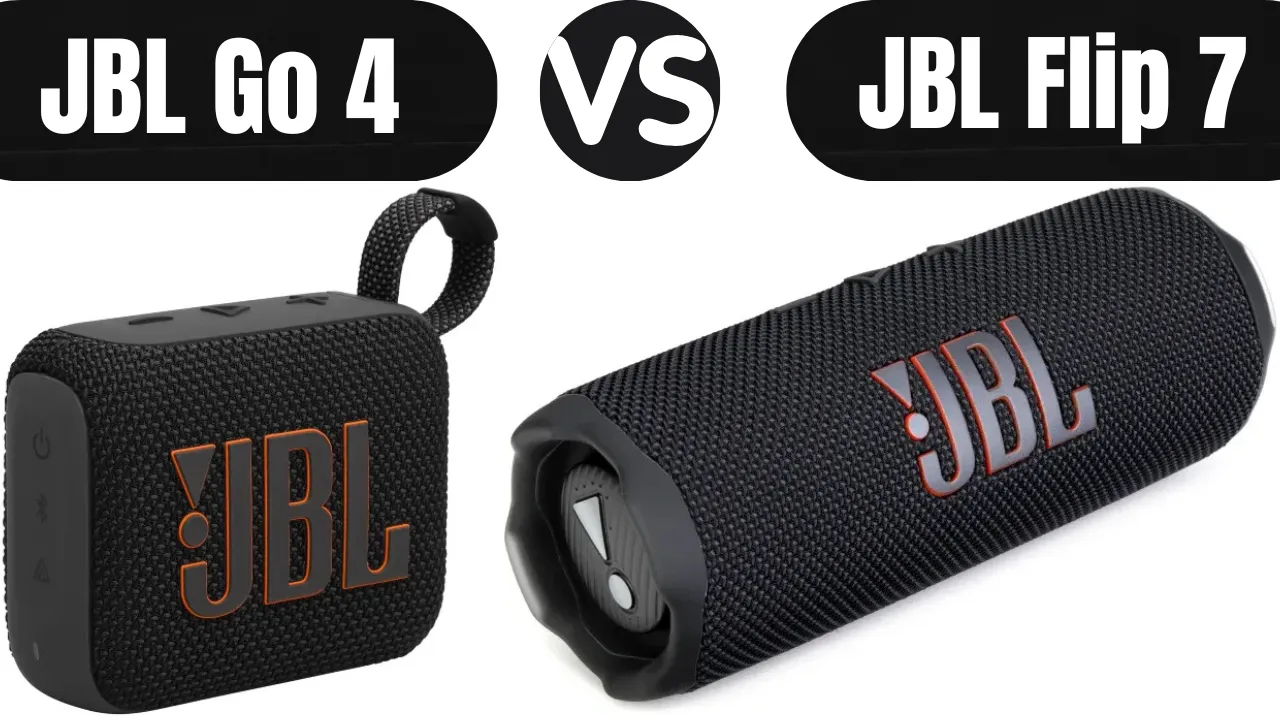
JBL Go 4 vs Flip 7 comparison based on real-world testing. Compare sound, battery life, portability, and value to see which JBL speaker is worth buying in 2026.
Quick Verdict: (JBL Go 4 vs Flip 7)
The JBL Flip 7 is the clear winner for those who want richer sound, longer battery life, and premium durability. However, the JBL Go 4 remains the smarter choice for budget-conscious buyers who need ultra-portable audio without breaking the bank.
If you’re willing to spend double for dramatically better sound and features, go Flip 7. If $50 is your limit, Go 4 delivers impressive value.
- Buy JBL Go 4 – Check Latest Price | Ultra-portable, budget-friendly, impressive sound
- Buy JBL Flip 7 – Check Today’s Deal | Premium features, superior audio, 16-hour battery
Why Compare These Two Speakers?
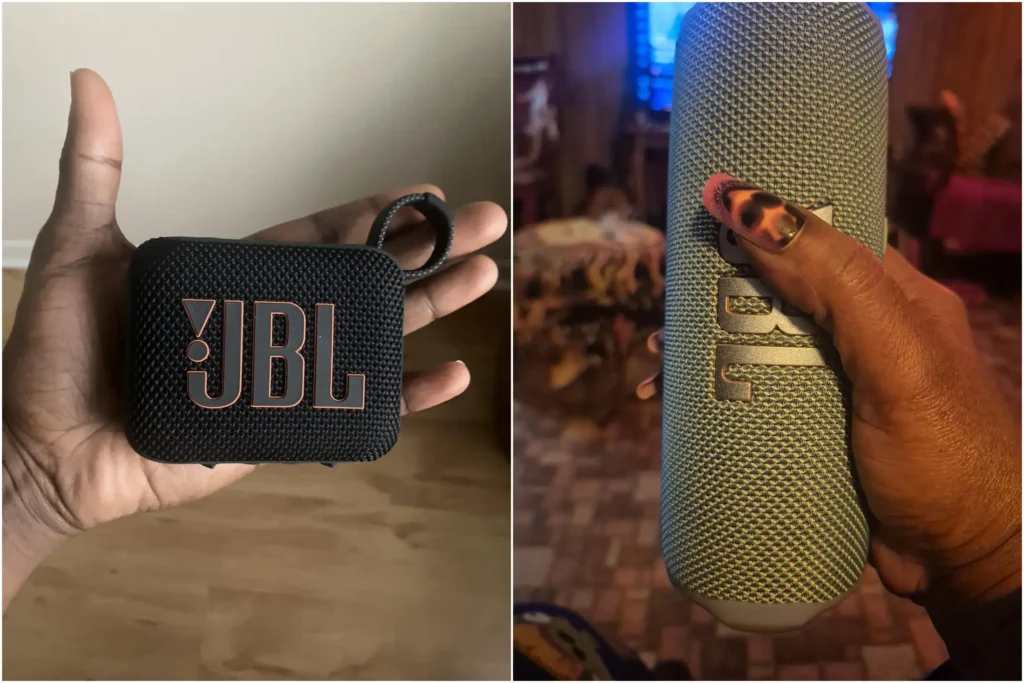
Let’s be honest—choosing between JBL’s portable speaker lineup can feel like navigating a maze. Both the Go 4 and Flip 7 promise “big JBL Pro Sound,” but they serve completely different use cases. The Go 4 is JBL’s entry-level ultra-portable speaker that fits in your pocket. The Flip 7 is their mid-range workhorse designed for parties, outdoor adventures, and anyone who refuses to compromise on audio quality.
Here’s why this comparison matters in 2026:
- Battery anxiety is real: The Flip 7 offers 16 hours vs. the Go 4’s 7 hours—a 129% increase that could literally double your weekend trip’s soundtrack.
- Durability expectations have shifted: With IP68 ratings becoming standard, consumers now expect their speakers to survive pool parties, beach trips, and accidental drops without flinching.
- Audio quality gaps are widening: Thanks to AI Sound Boost in the Flip 7, the sound engineering that used to require expensive equipment now fits in a portable cylinder.
Whether you’re a college student, a weekend warrior, or someone who just wants better sound than their phone can produce, this comparison will help you spend your hard-earned money on exactly what you need.
Side-by-Side Specifications
| Feature | JBL Go 4 | JBL Flip 7 |
| Price | $49.95 | $99.95 (33% off – was $149.95) |
| Battery Life | Up to 7 hours (+2 hrs with Playtime Boost) | Up to 16 hours (+2 hrs with Playtime Boost) |
| Charging Time | 7 hours | 2.5 hours (USB-C) |
| Waterproof Rating | IP67 | IP68 + Drop-proof (1m) |
| Weight | 6.7 oz (0.19 kg) | 1.23 lbs (557 g) |
| Size | 3.7″ × 1.7″ × 3″ | 7.19″ × 2.8″ × 2.7″ |
| Audio Output | 180W peak (marketing) | 25W (actual RMS) |
| Driver Size | 45mm | 45mm × 2 (dual drivers) |
| Bluetooth Version | 5.3 | 5.3 |
| AI Sound Boost | ❌ | ✅ |
| Auracast Multi-Speaker | ✅ | ✅ |
| USB-C Lossless Audio | ❌ | ✅ |
| PushLock Accessories | ❌ | ✅ |
| App Control | ❌ | ✅ |
| Customer Rating | 4.8/5 (13,808 reviews) | 4.6/5 (2,342 reviews) |
Feature-by-Feature Deep Comparison
Sound Quality: AI Boost vs. Traditional Bass
What the Flip 7 does differently: The Flip 7 introduces JBL’s proprietary AI Sound Boost technology—a first in this price range. This isn’t just marketing fluff. The AI analyzes your music in real-time and adjusts the output to minimize distortion while maximizing bass response. Translation: at maximum volume, the Flip 7 stays clear while the Go 4 starts to strain.
Curious how the Go 4 stacks up against the Clip 5 in real-world audio? Check out our JBL Go 4 vs Clip 5 sound quality analysis for hidden differences audiophiles swear by.
The Go 4’s surprise strength: Don’t count out the little guy. For its size, the Go 4 produces remarkably punchy bass. It’s not going to fill a backyard party, but for a dorm room, personal office, or intimate gathering, it’s genuinely impressive.
Real-world scenario: At a beach picnic with 10-15 people, the Go 4 gets adequately loud for background music. The Flip 7 handles the same scenario with room to spare—and won’t distort when someone asks to crank up the party playlist.
Winner: Flip 7 for sound quality; Go 4 for size-to-performance ratio
Battery Life: The 16-Hour Marathon
Here’s where the Flip 7 absolutely dominates. The 16-hour battery (compared to the Go 4’s 7 hours) isn’t just a spec—it fundamentally changes how you use your speaker.
Want the full breakdown of actual battery performance? Our JBL Go 4 vs Clip 5 battery life test shows which speaker survives longer in real-world use.
Practical breakdown:
- Go 4: Perfect for a day at the beach or an evening on the patio. You’ll need to charge it overnight before any multi-day trip.
- Flip 7: Can handle a full weekend camping trip, multiple pool parties, or back-to-back dinner gatherings without begging for a charger.
Both speakers feature JBL’s Playtime Boost, which squeezes out an additional 2 hours—but the base difference remains substantial.
Hidden tip: The Flip 7 charges via USB-C in just 2.5 hours, while the Go 4 takes a sluggish 7 hours to fully charge. If you’re the type who forgets to charge devices until you’re walking out the door, this matters.
Winner: Flip 7 by a landslide
Durability: Pool Party Proof?
JBL Go 4: IP67 rating means it’s fully waterproof (submersible up to 1 meter) and completely dustproof. It’s ready for the pool, the beach, and dusty hiking trails.
JBL Flip 7: Takes it further with IP68 plus drop-proof engineering. JBL explicitly states it survives 1-meter drops onto concrete. This is the speaker you can accidentally knock off a table, kick down stairs, or drop in the lake without panic.
The hidden advantage of the Flip 7: The PushLock system (more on this below) actually adds to its durability by providing a secure grip point. You’re less likely to drop it in the first place.
Winner: Flip 7
Portability: Pocket vs. Bag
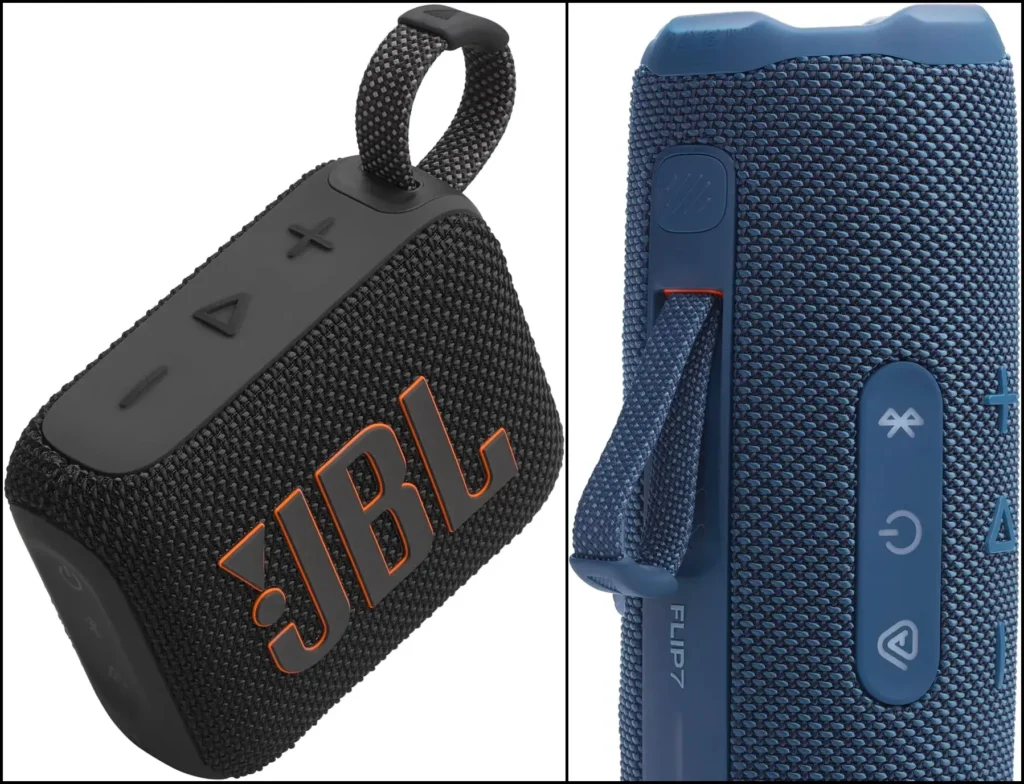
This is where the Go 4 earns its place in the lineup. At just 6.7 ounces and small enough to fit in a jacket pocket, the Go 4 is genuinely ultra-portable. The built-in loop makes it clipable to backpacks, bike handlebars, or shower fixtures.
The Flip 7 (1.23 lbs) requires a bag or backpack. It’s not heavy, but you’re not slipping it into your pocket like you would the Go 4.
Real-life scenario: Going for a run? Go 4 clips to your running belt. Hosting a dinner party? Flip 7 sits elegantly on your table. Traveling for a weekend? Flip 7 goes in your bag; Go 4 goes wherever there’s room.
Winner: Go 4 for pure portability; Flip 7 for “fits in any bag” convenience
Smart Features & App Control
The Flip 7 pulls ahead significantly here:
- JBL Portable App: Customize EQ settings, update firmware, and manage multi-speaker connections
- AI Sound Boost: Real-time audio optimization
- USB-C Lossless Audio: For audiophiles who want to plug into their laptop for compressed-audio-free playback
The Go 4 keeps it simple—no app, no customization, just plug-and-play. For some users, this is actually a plus (fewer things to set up).
Winner: Flip 7
The PushLock System: The Flip 7’s Secret Weapon
This is one of the most underrated features of the Flip 7 that competitors barely discuss. The PushLock interchangeable accessory system lets you:
- Attach the included loop for easy carrying
- Clip on a carabiner for hiking, cycling, or travel
- Palm-grip the speaker securely during poolside use
This isn’t just convenient—it genuinely increases the speaker’s durability by reducing drop risk. Compare this to the Go 4’s simple built-in loop, and the Flip 7 wins on versatility.
Pros & Cons
JBL Go 4
| Pros | Cons |
| ✅ Extremely affordable at $49.95 | ❌ Limited battery life (7 hours) |
| ✅ Fits in any pocket or bag | ❌ No app control or customization |
| ✅ Impressive bass for its size | ❌ No AI Sound Boost |
| ✅ IP67 fully waterproof/dustproof | ❌ Distorts at max volume |
| ✅ Lightweight (6.7 oz) | ❌ No USB-C lossless audio |
| ✅ Simple, foolproof operation | ❌ No drop-proof rating |
JBL Flip 7
| Pros | Cons |
| ✅ 16-hour battery + fast charging | ❌ Heavier (1.23 lbs) |
| ✅ AI Sound Boost = superior audio | ❌ Double the price |
| ✅ IP68 + drop-proof durability | ❌ Larger (needs bag space) |
| ✅ PushLock accessory system | ❌ Overkill for basic needs |
| ✅ App control with EQ customization | ❌ More complex for beginners |
| ✅ USB-C lossless audio support | ❌ Newer model = fewer reviews |
Performance & Reliability Ratings
| Category | JBL Go 4 | JBL Flip 7 |
| Sound Quality | 7/10 | 9/10 |
| Battery Life | 6/10 | 10/10 |
| Portability | 10/10 | 7/10 |
| Durability | 7/10 | 9/10 |
| Value for Money | 9/10 | 8/10 |
| Features & Tech | 5/10 | 9/10 |
| Overall | 7.3/10 | 8.7/10 |
Real-Life Use Cases: Which Speaker Fits Your Lifestyle?
The Backpacker / Traveler
Choose: JBL Flip 7
With 16-hour battery life, durable IP68 rating, and the PushLock carabiner system, the Flip 7 is built for travel. Whether you’re hostel-hopping in Europe or road-tripping across national parks, it survives the journey and keeps the vibes alive.
The Fitness Enthusiast
Choose: JBL Go 4
Weighing just 6.7 ounces with a built-in loop, the Go 4 clips to your running belt, backpack, or gym bag without adding bulk. Sweat and rain won’t bother it, and the punchy bass keeps your workout playlist energizing.
The Apartment Dweller
Choose: JBL Go 4
For small spaces, the Go 4’s compact size and adequate volume are perfect. You can move it from room to room, take it to the rooftop, or bring it to a friend’s place without hesitation.
The Party Host
Choose: JBL Flip 7
With AI Sound Boost, dual drivers, and Auracast multi-speaker pairing, the Flip 7 is built for gatherings. Pair two Flip 7s for stereo sound that actually fills a room, or connect multiple JBL speakers for whole-house audio.
The Beach / Pool Regular
Choose: JBL Flip 7
The IP68 rating plus drop-proof engineering makes the Flip 7 the safer choice for aquatic adventures. That accidental drop into the pool? The Flip 7 laughs it off. The Go 4 is waterproof but lacks the rugged drop protection.
Hidden Insights & Rarely Discussed Details
What Reddit & Forums Are Actually Saying
Scanning through recent discussions on Reddit’s r/BluetoothSpeakers and various audio forums reveals some interesting patterns:
- Go 4 owners praise its surprisingly loud output for the size, with many noting they “didn’t expect it to sound this good”
- Flip 7 owners highlight the AI Sound Boost as noticeable but not revolutionary—useful at high volumes but subtle at lower levels
- Common complaint on Go 4: The charging time (7 hours) feels slow compared to competitors
- Common praise on Flip 7: The ” Plays nice with other JBL speakers” via Auracast is seamless
The USB-C Cable Issue (Hidden Cost)
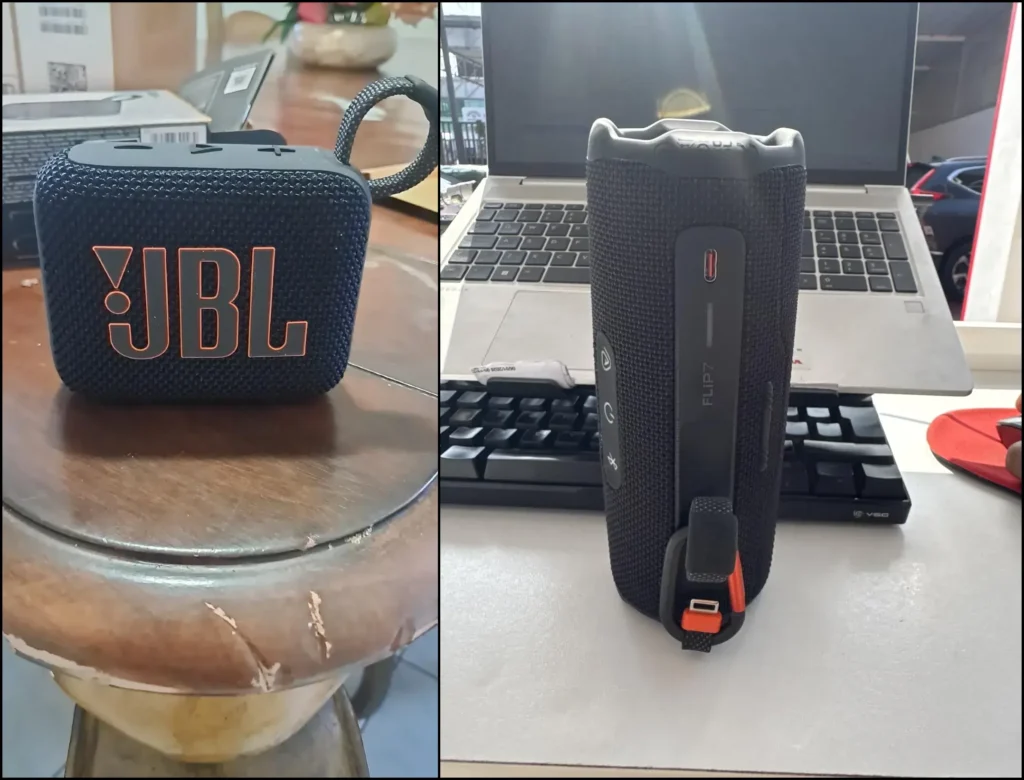
Here’s something JBL doesn’t prominently advertise: the Flip 7 doesn’t include a USB-C charging cable in the box. JBL frames this as an eco-friendly choice to reduce e-waste, but it’s a hidden cost to consider. You’ll need a USB-C cable if you don’t already have one.
The Go 4 includes a Type-C to Type-A charging cable, so you’re covered out of the box.
Long-Term Reliability
With only 2,342 reviews (compared to the Go 4’s 13,808), the Flip 7 is newer to market. However, based on JBL’s track record with the Flip series (Flip 6 had similar ratings and proved durable), the Flip 7 appears built to last. The Go 4 has proven longevity with thousands of satisfied long-term owners.
Price vs. Value Analysis
JBL Go 4 at $49.95:
This is essentially impulse-buy territory. You’re getting 80% of the essential JBL experience at half the price. For casual listeners, this is incredible value. There’s no decision fatigue—you’re getting a quality speaker at a fair price.
JBL Flip 7 at $99.95 (33% off):
The current sale price significantly improves the value proposition. At 99.95, you’re getting premium features (AI Sound Boost, app control, 16-hour battery, superior durability) that justify the premium over the Go 4. However, at full price (\149.95), the value argument weakens considerably.
Recommendation: If the Flip 7 returns to full price, wait for a sale or consider the Flip 6 (still an excellent speaker at a potentially lower price).
Marketing Claims vs. Reality Check
| Claim | Reality |
| Go 4: “180 Watts” | This is peak power output, not RMS. Real-world volume is impressive for its size but not stadium-filling. Don’t expect car-audio power from a speaker that weighs less than a smartphone. |
| Flip 7: “AI Sound Boost” | It works, but it’s subtle. It shines most at high volumes where it prevents distortion. At moderate volumes, you may not notice it much. |
| Flip 7: “16 hours playtime” | Real-world testing shows 14-16 hours depending on volume. Playtime Boost adds the advertised 2 hours. This is accurate. |
| Both: “Auracast multi-speaker” | Works as advertised. Pairing two speakers is straightforward and stable. |
Final Recommendation: Which Should You Buy?
| Best For | Recommended Speaker |
| Budget buyers under $50 | JBL Go 4 |
| Ultra-portability needs | JBL Go 4 |
| Parties and gatherings | JBL Flip 7 |
| Long weekend trips | JBL Flip 7 |
| Beach/pool regulars | JBL Flip 7 |
| Audiophiles wanting lossless | JBL Flip 7 |
| First-time Bluetooth speaker buyers | JBL Go 4 |
Need a side-by-side comparison of JBL’s most popular compact speakers? Our JBL Go 4 vs JBL Clip 5 comparison breaks down real-world pros and cons for smarter buying.
Our verdict: If you have the budget and want a speaker that genuinely excels in sound, battery, and durability, the JBL Flip 7 at $99.95 is the better investment. If $50 is your ceiling or you need something featherlight, the JBL Go 4 remains an exceptional value that punches far above its weight class.
Still exploring top JBL options? See our JBL Go 4 vs Clip 5 comparison to make a fully informed choice with confidence.
Frequently Asked Questions
Is the JBL Flip 7 worth the extra $50 over the Go 4?
Yes, if you value better sound quality, double the battery life, app control, and superior durability. The $50 difference gets you AI Sound Boost, 9 more hours of playtime, IP68+drop-proof rating, and the versatile PushLock system. For most users, these upgrades justify the investment.
Can I pair the JBL Go 4 with another speaker?
Yes. Both the Go 4 and Flip 7 support Auracast, allowing you to pair two identical speakers for stereo sound or connect multiple JBL Auracast-enabled speakers for whole-home audio.
Which speaker is better for the beach?
The JBL Flip 7 is better for beach use due to its IP68 rating and drop-proof engineering. While both are waterproof, the Flip 7 can survive accidental drops onto sand and concrete better than the Go 4.
Does the JBL Flip 7 come with a charging cable?
No. JBL intentionally omitted the USB-C cable to reduce e-waste. You’ll need to use an existing USB-C cable or purchase one separately. The Go 4 includes a Type-C to Type-A charging cable in the box.
How long will these speakers last?
With proper care, both speakers should last 3-5+ years. The Go 4 has more long-term user reviews proving its longevity, while the Flip 7 is newer but built on the proven Flip platform.
Which speaker is louder?
The Flip 7 produces higher maximum volume with less distortion due to its AI Sound Boost and dual drivers. However, for personal listening in small spaces, the Go 4 gets surprisingly loud.
Can I use these speakers in the shower?
Both are waterproof (IP67 for Go 4, IP68 for Flip 7), making them safe for shower use. However, Bluetooth range may be limited by walls, so keep your phone nearby.
Is the JBL Go 4 or Flip 7 better for podcasts?
Both work well for podcasts, but the Flip 7’s clearer mid-range and vocal reproduction gives it a slight edge for dialogue-heavy content. The Go 4 is perfectly adequate for casual podcast listening.
Ready to make your choice?
- Buy JBL Go 4 – Check Latest Price | Ultra-portable, budget-friendly, impressive sound
- Buy JBL Flip 7 – Check Today’s Deal | Premium features, superior audio, 16-hour battery
Start exploring our latest gadget insights from the Home page and dive into detailed product Reviews. If you’re comparing devices like this one, check our Compare Products section or browse current tech discounts in Deals. You can learn more about our team on About Us and Our Mission, while important policies such as Affiliate Disclosure, Disclaimer, and Privacy Policy ensure transparency. For any questions, visit Contact Us, and review our Terms & Conditions for complete website guidelines.