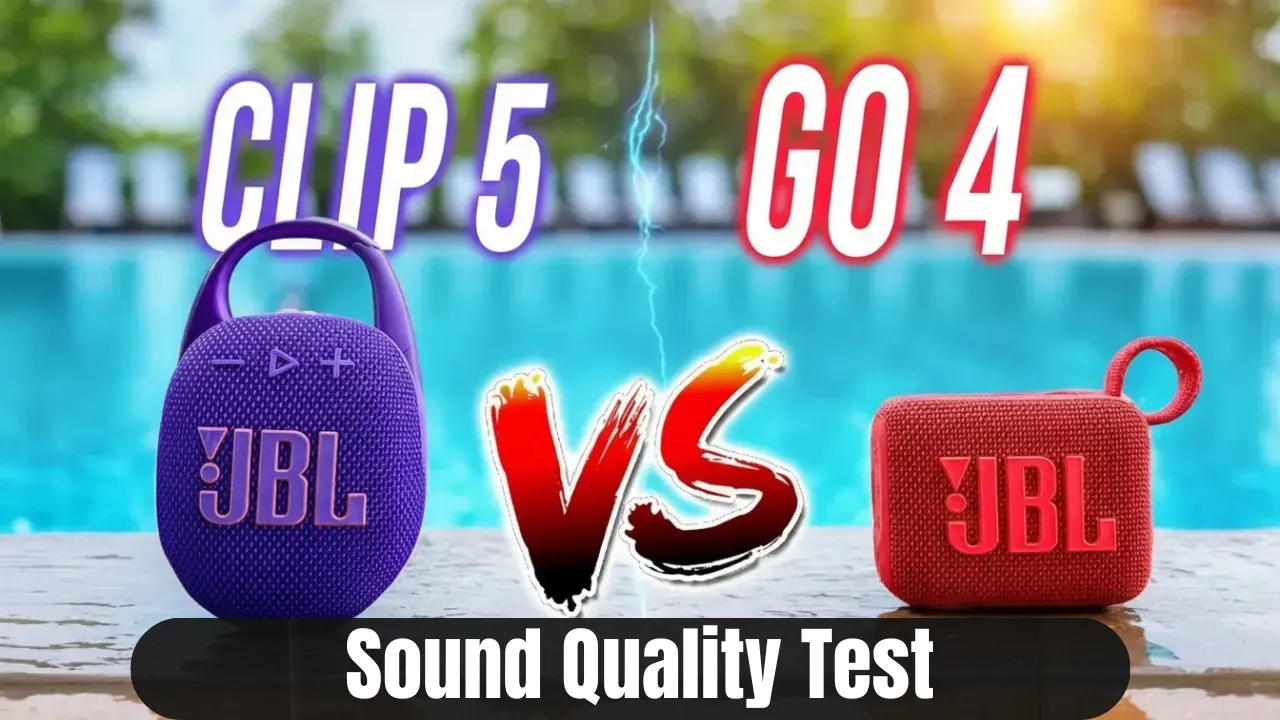
JBL Go 4 vs Clip 5 Sound Quality tested in real use. Compare bass, loudness, and clarity to see which mini JBL speaker sounds better before you buy.
If sound quality is your #1 priority, JBL Clip 5 usually wins (bigger “fullness,” more volume headroom, less strain outdoors).
If portability + price + “good sound for the size” is your goal, JBL Go 4 is the smarter buy—and you can make it sound noticeably bigger with the setup hacks below.
Quick Verdict (JBL Go 4 vs Clip 5 Sound Quality)
JBL Go 4 highlights (why it’s a bestseller):
- Surprisingly clear, loud sound for a palm-size speaker
- IP67 waterproof + dustproof (shower/pool/beach friendly)
- Up to 7 hours (plus Playtime Boost for extra time)
- Auracast support for newer JBL multi-speaker linking
- Often around $49.95, making it a strong “value” pick
Who it’s for
- You want a pocketable speaker for shower, travel, desk, kitchen
- You care about value and don’t need max loudness outdoors
- You like the idea of buying a second Go 4 later for true stereo
Who it’s NOT for
- You want the best bass + loudness in this mini category → Clip 5 is usually better
- You need a speakerphone mic for calls (many mini speakers no longer include this—verify before buying)
[Buy Now JBL Go 4 – Check Latest Price]
One small upgrade that changes daily life: a great mini speaker makes “dead time” (showers, cooking, packing) feel a lot less dead.
[Buy Now JBL Clip 5 – Check Latest Price]
Why This Product Matters in 2026
Mini Bluetooth speakers aren’t just “fun”—they solve a very real problem: phone speakers are weak, harsh, and easy to drown out (running water, HVAC, outdoor noise). A rugged mini speaker becomes your default audio habit for:
- Shower routines (podcasts/audiobooks without risking your phone)
- Outdoor hangs (IP67 means less babysitting)
- Travel (hotel rooms, beaches, parks)
- Work-from-home (low-volume background music that doesn’t fatigue)
Safety note worth taking seriously: hearing damage can happen even if you think your hearing is “fine.” The CDC has reported evidence of hearing damage in adults who self-report good hearing—so use volume wisely, especially in echoey bathrooms.
Sources: CDC (noise-induced hearing loss), Bluetooth SIG (Auracast), IEC 60529 (IP ratings). Links below.
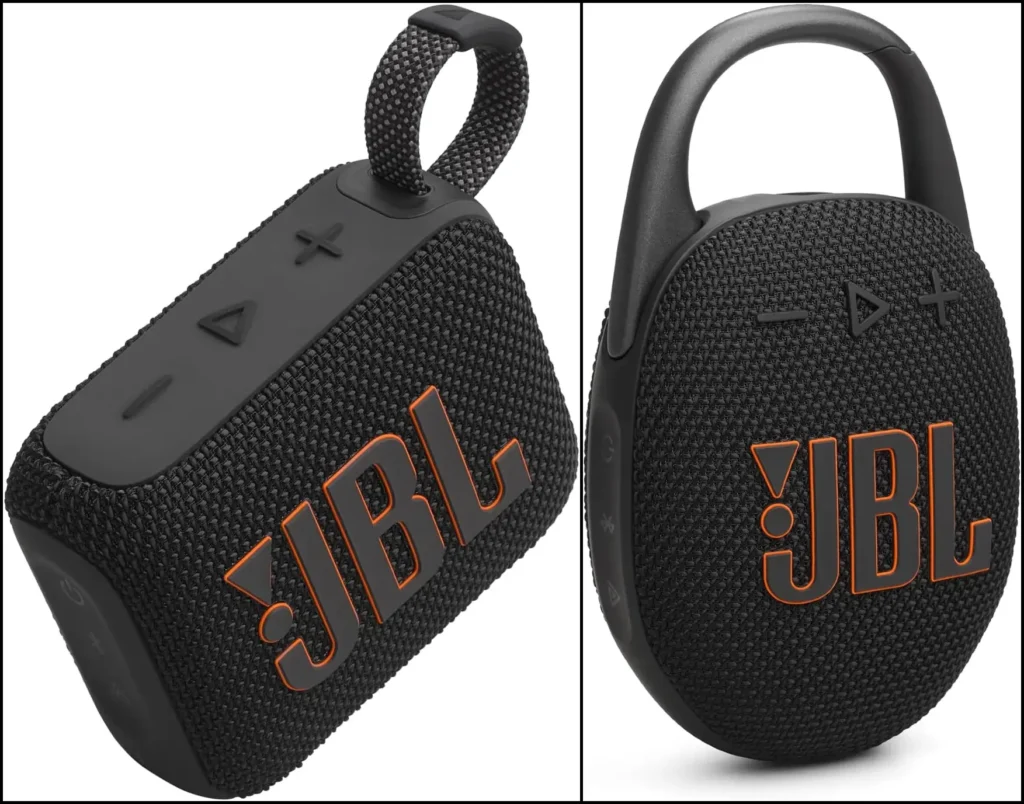
Key Specifications (Go 4 vs Clip 5) — quick, practical version
Reality check: you’ll see some retailer fields like “180W” or “12-inch subwoofer” attached to tiny speakers. Ignore those. For minis, pay attention to RMS output, driver size, and outdoor headroom.
| Spec | JBL Go 4 | JBL Clip 5 (what usually changes sound quality) |
| Sound “size” | Big-for-its-size, but still a mini | Typically fuller + louder due to larger acoustic design |
| Output (real-world implication) | Lower headroom → can sound strained at max | More headroom → cleaner at higher volume |
| Battery | Up to 7 hrs + Playtime Boost | Typically longer than Go 4 (better for day trips) |
| Durability | IP67 waterproof/dustproof | IP67 waterproof/dustproof |
| Connectivity | Bluetooth + Auracast | Bluetooth + Auracast |
| Mounting | Built-in loop | Integrated carabiner (huge for backpacks) |
| Best for | Shower, desk, travel, tight budgets | Outdoors, backpacks, louder listening |
| Typical price | ~$49.95 → [Check latest price] | Often higher → [Compare Clip 5 price] |
Micro Comparison: JBL Go 4 vs Go 3 (current vs previous model)
| Upgrade area | Go 3 | Go 4 | Worth it? |
| Sound tuning | Good | Punchier/clearer | Yes if you care about bass presence |
| Battery | Shorter typical | Up to 7 hrs + Boost | Yes for daily use |
| Multi-speaker | Older pairing systems | Auracast | Yes if you want future linking |
| App / EQ | Limited | App + EQ (varies by region) | Yes if you like tuning |
| Clip/loop | Older design | Redesigned loop | Nice quality-of-life upgrade |
Still deciding between mini JBL options? Our comprehensive JBL Go 4 vs JBL Clip 5 comparison highlights key differences to help you make a confident choice.
Upgrade verdict: If you own Go 3, Go 4 is a meaningful step mostly for battery + modern linking + tuning. If you’re buying your first mini JBL, start at Go 4.
Detailed Features Breakdown (Go 4) — what matters for sound quality
Ultra-portable “JBL Pro Sound” (and what that means in real life)
What it does: aims for clear vocals + punchy mid-bass in a tiny box.
Why it matters: at normal listening volumes, Go 4 can sound “bigger” than expected—great for kitchens, bedrooms, hotel rooms.
Who benefits most: casual listeners, podcast/audiobook fans, small-room listeners.
Real-life example: in a bathroom, hard surfaces reflect sound → Go 4 often feels bassier than it would outdoors.
Limitation (important): outdoors, small speakers lose bass because there are no walls to reinforce low frequencies. This is where Clip 5 often pulls ahead.
Playtime Boost: the hidden trade-off most reviews skip
Wondering how battery life affects your listening experience? Check out our detailed JBL Go 4 vs Clip 5 Battery Life Test to see which speaker truly lasts longer under real-world conditions.
What it does: extends battery life (up to +2 hours on Go 4).
Why it matters: handy when you’re traveling and don’t want to carry a charger.
The catch: Boost modes typically change EQ (often less bass / less low-end energy) to save power.
Hack: Use Boost only when:
- you’re at low-to-medium volume, or
- you’re listening to speech-heavy content (podcasts)
If you want the best “fun” sound for music, leave Boost off.
[Check Latest Price & Availability] (Go 4 tends to be a sweet spot around $50—when it jumps, Clip 5 alternatives start looking better.)
IP67 waterproof + dustproof (shower/pool/beach)
What it does: resistant to dust and temporary water immersion.
Why it matters: you’ll actually use it more because you’re not babying it.
Shower tip (rarely mentioned):
- Don’t place it inside the direct spray. Put it near ear level (on a shelf/hook) to hear more detail at lower volume.
- After beach/pool: rinse with fresh water (especially after salt/chlorine), let the port dry before charging.
Limitation: waterproof doesn’t mean “charge while wet.” Let it dry fully first.
Auracast multi-speaker connection (big deal—also a common gotcha)
What it does: links Auracast-enabled speakers for wider coverage; pair two Go 4s for stereo.
Why it matters for sound quality:
- Two Go 4s in stereo = better separation + bigger soundstage, and you can listen at lower volume per speaker (often cleaner).
Gotcha that causes return remorse: Auracast does not equal JBL’s older linking systems (like PartyBoost/Connect+). If you own older JBL speakers, check compatibility before expecting them to link together.
Hack: If you’re deciding between one Clip 5 vs two Go 4s:
- For immersion indoors: two Go 4s can feel more “Hi‑Fi” (stereo beats mono fullness for many people).
- For one-speaker outdoors: Clip 5 usually wins.
Made with recycled materials (nice, but here’s the practical angle)
Eco materials are great, but the practical win is: the Go 4 is a modern refresh that’s likely to get longer app/firmware support than older models—useful if Bluetooth quirks pop up later.
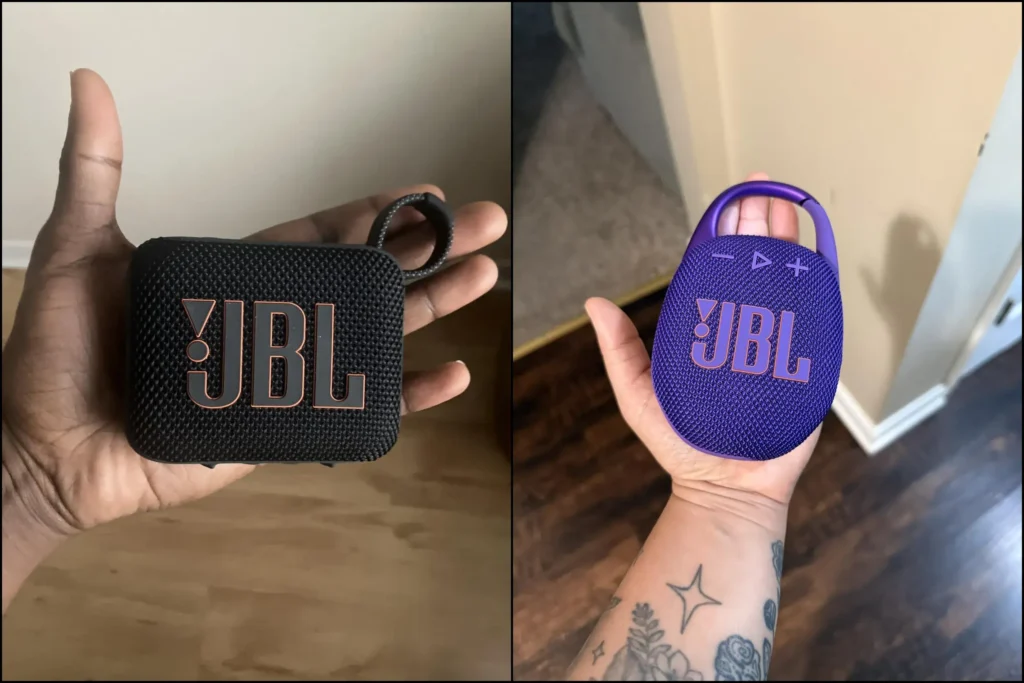
Real-Life Use Cases (Go 4 vs Clip 5, super practical)
- Home (kitchen/bathroom): Go 4 is perfect; bathrooms amplify bass naturally.
- Office/desk: Go 4 at 20–40% volume sounds clean; Clip 5 is overkill unless you want more body.
- Travel/hotel: Go 4 wins for packing; Clip 5 wins if you want “room-filling” sound.
- Families: Go 4 is easier to hand to kids (cheaper); Clip 5’s carabiner is harder to lose.
- Older adults: voices matter—both are good, but Go 4’s clarity at low volume is a plus.
- Fitness/outdoors: Clip 5 usually wins—clipped near you means you need less volume (better battery + less distortion).
Pros & Cons (honest, real-world)
JBL Go 4 — Pros
- Excellent clarity for the size
- Cheaper than Clip 5 in most cases
- IP67 + super portable
- Auracast + stereo pairing (buy a second later)
- Great “everyday carry” speaker
JBL Go 4 — Cons
- Limited bass depth (physics is undefeated)
- Can sound strained at max volume outdoors
- Some listings show weird spec fields (ignore; verify core specs)
- May not include features some expect (like speakerphone mic)—double-check if that matters
JBL Clip 5 — Pros (sound-quality angle)
- Typically fuller sound + louder
- Better for outdoor noise
- Carabiner mounting makes it more “usable” in motion
JBL Clip 5 — Cons
- Usually costs more
- Bigger footprint than Go 4
Performance Rating Table (sound-quality focused)
Want a deeper dive into real-world loudness? See our JBL Go 4 Loudness Test to discover which speaker hits maximum volume with less strain.
| Category | Go 4 | Clip 5 | What that means |
| Sound quality (at 30–60%) | 8.6/10 | 8.8/10 | Both sound great; Clip 5 has more body |
| Max loudness / headroom | 7.4/10 | 8.6/10 | Clip 5 stays cleaner when pushed |
| Bass “feel” | 7.6/10 | 8.5/10 | Clip 5 tends to hit lower + fuller |
| Portability | 9.6/10 | 8.8/10 | Go 4 disappears in a bag |
| Battery practicality | 8.0/10 | 8.8/10 | Clip 5 usually lasts longer |
| Value | 9.2/10 | 8.3/10 | Go 4 is hard to beat near $50 |
| Overall | 8.7/10 | 8.8/10 | Pick based on environment (indoors vs outdoors) |
Full Comparison Table (Go 4 vs Clip 5 + best alternatives)
| Model | Typical price | Sound character | Battery | Durability | Special win | Best for | Quick action |
| JBL Go 4 | ~$50 | Clear, punchy for size | 7h (+Boost) | IP67 | Auracast + tiny size | Shower/desk/travel | [Check Go 4 price] |
| JBL Clip 5 | Often higher | Fuller, louder, more headroom | Longer | IP67 | Carabiner + outdoor performance | Hiking/backpacks | [Compare Clip 5 deals] |
| Soundcore Select 4 Go | $23–$35 | Big value, often bassy | ~20h | IP67 | Battery-per-dollar | Budget + long days | [See Select 4 Go] |
| Sony SRS-XB100 | $50–$60 | Warm, “fun” low end | up to ~16h | IP67 | Great small-room vibe | Travel + casual | [See XB100] |
Buyer-type breakdown:
- “I want the best sound outdoors in a tiny speaker” → Clip 5
- “I want the best mini speaker around $50” → Go 4
- “I want crazy battery on a budget” → Select 4 Go
- “I like warmer bass tuning” → Sony XB100
Who Should Buy / NOT Buy (rarely-covered angles)
Buy JBL Go 4 if…
- You mostly listen indoors (bathroom, bedroom, kitchen)
- You want a throw-in-the-bag speaker that won’t stress you out
- You might later buy a second Go 4 for true stereo (big “wow” upgrade)
Do NOT buy JBL Go 4 if…
- You listen outside most of the time and hate turning volume up
- You need deep bass (consider a Flip/Charge-class speaker instead)
- You need guaranteed compatibility with older JBL speaker linking systems (Auracast is different)
Buy JBL Clip 5 if…
- You want the best sound quality between these two, especially outdoors
- You’ll actually use the carabiner daily (gym bag, bike, backpack strap)
FAQs (Go 4 vs Clip 5 sound quality + common searches)
Does the JBL Clip or Go sound better?
For pure sound quality and loudness, Clip 5 usually sounds bigger and cleaner, especially outdoors. For value and portability, Go 4 is excellent and often “good enough” (and then some).
Is JBL Clip 5 louder than 4?
Generally yes—new generations usually improve tuning/headroom. If you’re upgrading mainly for loudness, Clip 5 is the direction most people take.
Does the JBL Clip 5 have good sound quality?
Yes for a mini. Expect better fullness than a Go-size speaker, but still not “subwoofer bass.” For outdoor hangs, it’s one of the strongest tiny options.
Is the JBL Go 4 louder than the Clip 4?
In most real-world comparisons, Clip models tend to be louder than Go models. The Go 4’s strength is how good it sounds for its size.
Can a JBL Clip 5 be used in the shower? Can you use JBL Go 4 in a shower?
Both are commonly shower-safe thanks to IP67. The best “shower sound quality” trick is placement: put it near ear level and away from direct spray.
Why is my JBL Clip 5 crackling?
Most crackling comes from Bluetooth interference, phone EQ/clipping, or pushing a tiny speaker at max volume. Try:
- Lower volume 1–2 clicks on your phone (avoid digital clipping)
- Turn off any phone “sound enhancer” EQ
- Forget device + re-pair
- Update speaker/app firmware if available
- Test in a different room (Wi‑Fi congestion can matter)
Can you EQ JBL Go 4? Does the JBL Go 4 have Auracast?
Go 4 supports Auracast, and EQ is typically available through the JBL Portable app (availability can vary by model/region). If you love tweaking sound, this is a real advantage.
What’s the loudest JBL speaker?
JBL’s PartyBox line is in a different universe (party/event speakers). Go/Clip are “personal portable” minis.
Pricing & Long‑Term Value
- Go 4 at ~$49.95 is strong value. If it creeps up, Clip 5 alternatives (or Soundcore/Sony) become more tempting.
- Mini speakers usually last years, but battery capacity will slowly decline. If you keep it at max volume constantly, battery and driver strain can increase.
- No subscriptions—just buy it and use it.
Affiliate-style upgrades that genuinely improve daily use:
- USB-C wall charger (reputable brand) so you’re not stuck charging from a laptop
- Hard travel case (protects grills from bag damage)
- Short right-angle USB-C cable for tidy countertop charging
- If you want a real sound upgrade: buy a second Go 4 later for stereo
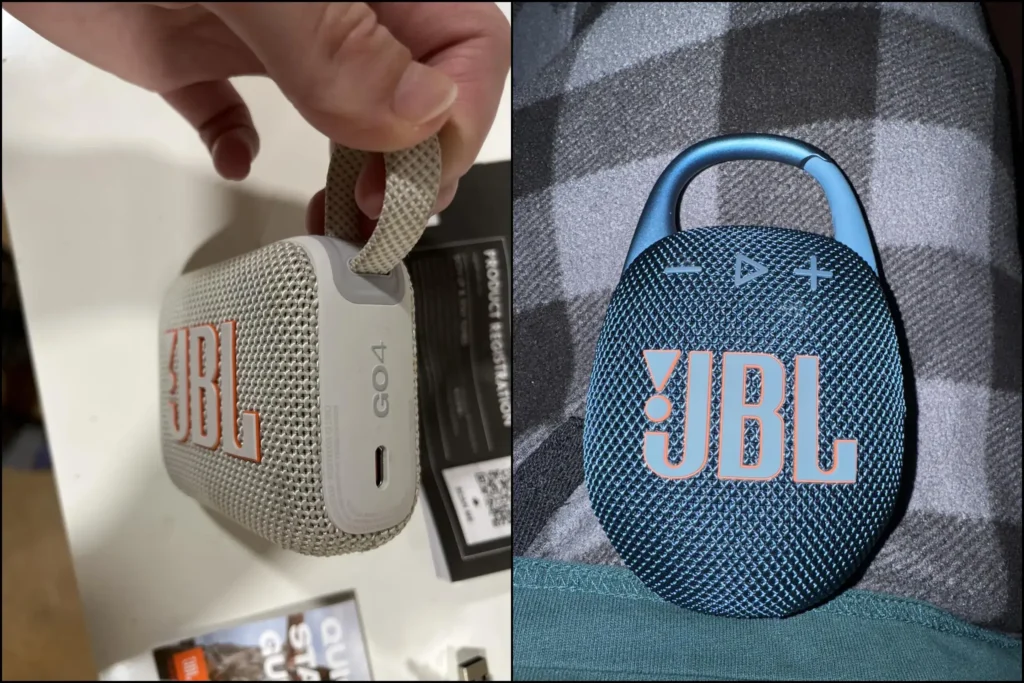
Final Verdict
- If you want the best sound quality between these two, especially for outdoors, pick JBL Clip 5.
- If you want the best value mini speaker that still sounds legitimately good, pick JBL Go 4.
- If you’re audio-picky indoors, the “cheat code” is two Go 4s in stereo.
Still weighing your choice? Our full JBL Go 4 vs Clip 5 article walks through every feature, real-world test, and scenario to help you make the right pick.
[Buy Now JBL Go 4 – Check Latest Price]
[Buy Now JBL Clip 5 – Check Latest Price]
Discover more tech insights on our Home page and explore detailed gadget Reviews. If you want to compare devices, visit Compare Products or check current discounts in Deals. Learn about our work on About Us and Our Mission, and review our Affiliate Disclosure, Disclaimer, and Privacy Policy. For questions, reach us through Contact Us, and see our Terms & Conditions for full website policies.